Efforts by the South Korean government to reduce the tariff hike imposed by US President Donald Trump last week appear to have failed.
The country’s trade minister told reporters in Seoul on the weekend that while some “unnecessary misunderstandings” had been resolved, but he and other officials had been unable to stop Washington increasing tariffs on Korean exports from 15% to 25%.
Minister of Trade, Industry and Resources Kim Jung-kwan, who flew back to Seoul on Saturday, said he met twice with US Secretary of Commerce Howard Lutnick in Washington on Thursday and Friday, but the “measures to raise tariffs [on Korea] have already begun.”
ALSO SEE: ‘Ghost Tankers’ From Iran Ferried Jet Fuel to Myanmar Airforce
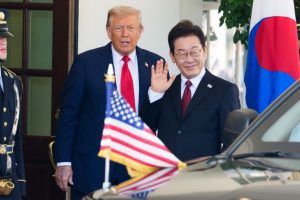
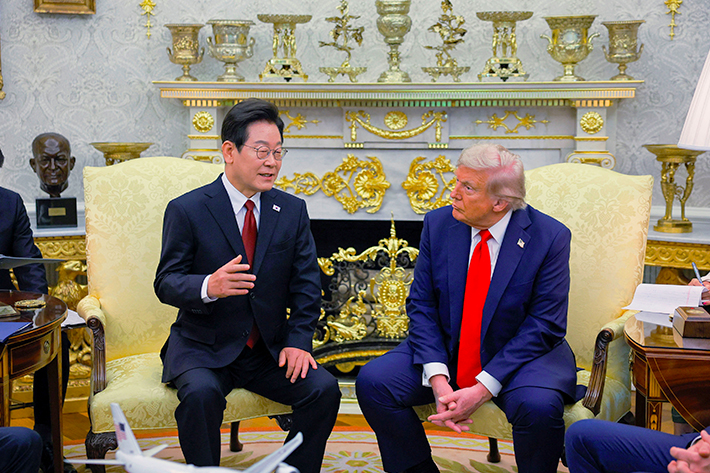
President Trump hiked tariffs on South Korean goods to 25% last week after asking, in a post on social media, why the Korean legislature had failed to approve the trade agreement reached last year with President Lee.
The trade, industry and resources minister plans to continue talks via video calls with Lutnick and other US officials, plus trade representative Yeo Han-koo has stayed in the US for a few more days to meet with his US counterpart Jamieson Greer and discuss bilateral issues.
“The Korean government will actively demonstrate its willingness to implement the Korea-US tariff agreement,” a senior official at the presidential office told Korea JoongAng daily on Sunday.
Focus on Assembly vote
The Korean delegation explained that they need the National Assembly to pass a special law on the massive investments — some $350 billion — it has vowed to make in the US, but the ruling Democratic Party’s chief policymaker Han Jeoung-ae has said that is not due to happen till late this month or early March.
Kim, the trade minister who returned to Seoul, said this is the key concern for US officials.
Han was quoted as saying the government’s hands were tied due to the lack of a legal basis for the deal. But they will try to keep to the National Assembly’s deadline with a vote at the end of this month.
“If the National Assembly follows the set timetable for the bill, I think negotiations between Korea and the United States will progress.”
But he suggested the government may need to consider other moves to show the United States that Korea is committed to keeping its side of the agreement.
The Koreans said last year that the huge amount pledged in October is a major risk for their economy and they would have to limit outlays to $20 billion a year, from mid-2026, to prevent a severe impact on the won, as their currency has been weak.
There is also uncertainty about the deal because the US Supreme Court has yet to rule on whether Trump’s tariffs were imposed legally.
In November, Supreme Court justices cast doubt on Trump’s authority to impose tariffs under the 1977 International Emergency Economic Powers Act (IEEPA), which contains no references to tariffs – only language on regulating imports during national emergencies declared by the US president.
Meanwhile, there have also been claims that Trump may have imposed the tariff hike because he was unhappy with recent South Korean regulatory actions against Coupang, a US-listed e-commerce company that has complained that the moves were unfair and discriminatory.
Korean stocks down 5%
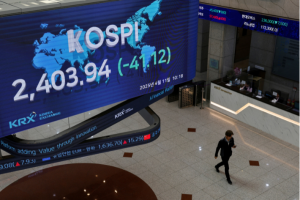
Stock exchange authorities called a temporary halt to trading in Seoul after the Kospi index fell by more than 5% to 4,949.67 on Monday.
Kospi 200 futures also fell by a similar margin, while the small-cap Kosdaq slid by 4.44% at the close of trading.
Other markets in the Asia-Pacific were also down, as the price of gold and silver continued to fall. The Nikkei dropped by 1.25% to 52,655.18, while the Topix slipped by 0.85% to 3,536.13.
The Hang Seng Index in Hong Kong also declined by 2.32%, while the CSI 300 on the mainland fell 2.13% to 4,605.98. And the S&P/ASX 200 in Sydney was down by 1.02% to 8,778.6.
Gold lost around 6%, falling to $4,538 per ounce, after a 10% plunge on Friday, when prices dropped below $5,000 an ounce. Spot prices for silver were down a further 12% on Monday to $74.36 an ounce.
- Jim Pollard
NOTE: Regional stock and commodity prices were added to this report on Feb 2, 2026.
ALSO SEE:
Seoul Vows to Act on US Investments, After New Tariff Threat
US, Korea reveal details on building ships and nuclear subs
Supreme Court defeat seen adding to uncertainty on Trump tariffs
Hyundai raid: How a visa loophole landed Korean workers in trouble
S Korea’s Lee will try to pacify Trump with big shipbuilding boost
S Korea to invest $350bn in US projects, energy; gets 15% tariff