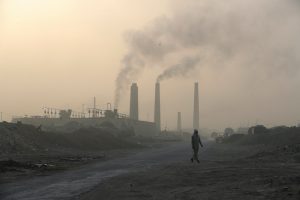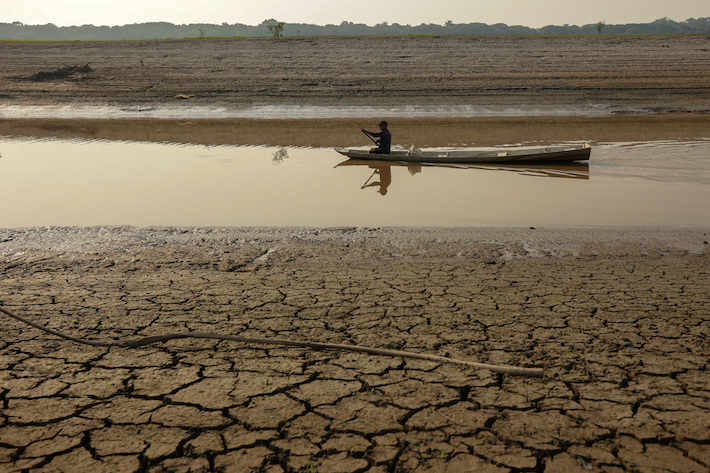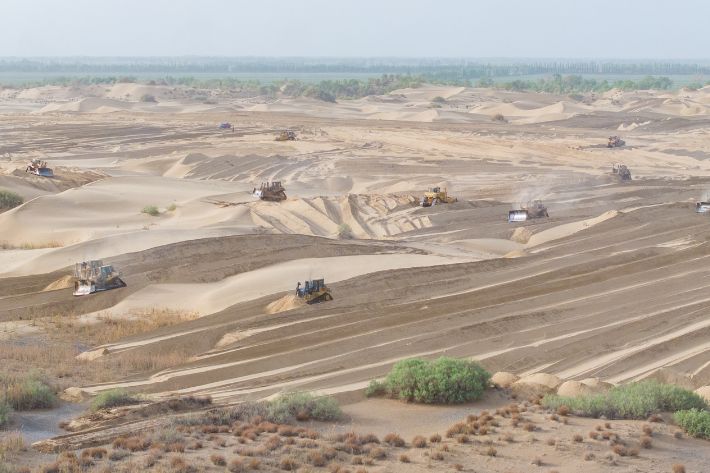
China’s efforts to slow land degradation and the expansion of deserts in the country’s west by planting vast numbers of trees and restoring grasslands have altered the country’s water cycle, according to a new report.
Projects to boost vegetation cover have been implemented for more than four decades with mixed success. But a recent study of hydrological changes over the two decades to 2020 said afforestation, grassland restoration, and cropland redistribution had transformed the land surface, as well as hydrological conditions and water resources management.
These enormous long-term “regreening” efforts have moved water in ways that scientists are only beginning to grasp – through atmospheric moisture recycling.
ALSO SEE: Asia-Pacific ‘Faces $500bn Yearly Floods Hit if Warming Continues’
These moves, to mitigate climate change and ensure food security, caused hydrological impacts via a process known as evapotranspiration and precipitation (rain).
The seven researchers found that forest expansion in China’s eastern monsoon region and grassland restoration in other parts of the country increased evapotranspiration – but rainfall only increased in the Tibetan Plateau region, while other regions endured a drop in water availability.
They said China had undergone rapid land use/ cover changes “such as afforestation, grassland restoration, and cropland redistribution, which have substantially transformed the terrestrial surface and affected hydrological conditions and water resources management.”
But they were frank in conceding that “the hydrological impacts of these changes, particularly through atmospheric moisture recycling processes, remain insufficiently understood.”
One of China’s challenges stems from uneven rainfall, which is something the government has long sought to remedy. The north of the country, which has nearly half of the population (46%) and 60% of arable land, only has about 20% of the country’s water, according to the study.
“Expanding forests in eastern China and restoring grasslands in the Tibetan Plateau and northwest regions were the main factors boosting evapotranspiration. These shifts caused changes in precipitation, directing more moisture to the Tibetan Plateau, which saw an increase in water availability,” the study said.
“In contrast, eastern and northwestern China experienced a decrease in WA [water availability], with the northwest losing the most due to substantial moisture moving to the Tibetan Plateau.”
Great Green Wall and other projects
China’s Great Green Wall project, which began in the late 70s, helped lift the amount of forest cover on China’s land area from about 10% of China’s area to more than 25%, state media proclaimed in November 2024, when a 3,000km green belt was completed around the Taklamakan Desert in Xinjiang.
One of the reasons for this huge effort was to reduce sandstorms, which regularly plagued Beijing. But even with the continuing tree planting, 26.8% of China’s land area is still classified as “desertified”, according to official data from the forestry bureau, only a slight fall from 27.2% a decade ago, Reuters reported last year.
A report in Live Science last week noted positive impacts from other large regreening projects in China, such as the Grain for Green Program and the Natural Forest Protection Program, which both started in 1999.
But the tricky part, as the latest study found, was that wind can transport evaporated water (or moisture) for huge distances – up to 7,000km in desert areas.
The Grain for Green Program involved 124 million people in 25 provinces. It provided an incentive for farmers to convert farmland into forest and grassland. By 2010, around 15 million hectares of farmland and 17 million hectares of barren mountainous wasteland were converted back to natural vegetation, according to a study cited by Wikipedia.
Meanwhile, the Natural Forest Protection Program, which banned logging in primary forests and promoted afforestation, helped China become a global leader in forest restoration and greening. The country was able to boost its national forest coverage total to just over 24% in 2022.
Biodiversity benefits
A report published by Nature late last month, found that “China’s restoration efforts have demonstrably enhanced a range of forest ecosystem services (including food production, carbon sequestration, soil retention, sandstorm prevention, water retention, flood mitigation, and climate mitigation), as well as socio-economic services (including livelihood improvement, poverty alleviation, job creation, and economic development).”
It said expanding forests provided “substantial biodiversity benefits” by improving forest structure through enhanced tree cover and canopy structural complexity. It expanded the habitat for 73% of avian species.
“Our findings suggest that restoring planted forests in degraded landscapes can provide substantial biodiversity benefits,” it said.
Between 2000 and 2020, the forested area in mainland China increased by 21,775 square kilometres, the report said, with the largest increase occurring in the north and the only net reduction in the south.
Chinese loggers now plunder Myanmar
However, there have also been severe negative impacts from China’s ban on logging. The most notable has been the plunder of forests in northern Myanmar, which has been well documented by international activists.
“In 2004, more than 1 million cubic metres of timber, about 95% of Burma’s total timber exports to China were illegally exported from northern Burma to Yunnan Province,” Global Witness reported in 2005.
“This trade, amounting to a $250 million loss for the Burmese people, every year, takes place with the full knowledge of the Burmese regime, the government in Beijing and the rest of the international community. Chinese companies, local Chinese authorities, regional Tatmadaw [Myanmar military] and ethnic ceasefire groups are all directly involved,” it said.
That illegal timber trade continues, sadly. The Organized Crime and Corruption Reporting Project reported in 2021 that about $600 million worth of timber was being trucked or shipped out of the country every year, with 80% going to China.
And with the coup that ousted Aung San Suu Kyi and the civil war that erupted that year, the exploitation of Myanmar’s natural resources has gotten much worse, involving jade, rare earth mines and more.
A 2023 report by the Environmental Investigation Agency (EIA) said illegal logging tied to Chinese firms had ravaged extensive areas of Myanmar’s forests, notably in the northern regions such as Kachin and Shan states.
Mongolia linked to Beijing’s dust storms
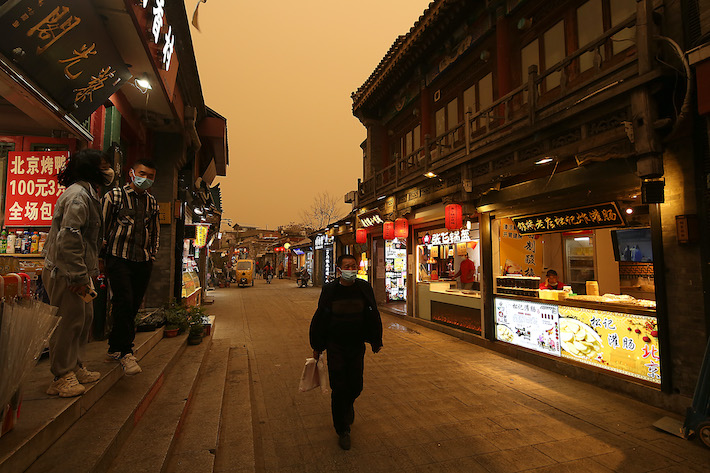
Another neighbouring country has also been drawn into these environmental battles, as Chinese scientists and officials have claimed that Mongolia is a cause of the huge dust storms that disrupted life in Beijing and other parts of the north in recent years.
More precisely, Chinese citizens have claimed that herders and miners in Mongolia are destroying their country’s grasslands through their alleged exploitation of natural resources.
But a recent report in The Conversation noted that Chinese demand for Mongolian resources is also a factor, with mining trucks in the south of Mongolia accused of churning up dust by “carrying coal to China on unpaved roads.”
A UN conference is due to be held in the Mongolian capital Ulaanbaatar to discuss how to tackle desertification in August next year, as three-quarters of Mongolia’s land is now classified as degraded.
While China has blamed Mongolian herders as causes of land degradation, others have said the privatisation of grassland use and the erection of fencing is a bigger factor in the desertification of China’s grasslands, because it localises grazing pressure and prevents herders from moving their stock around.
- Jim Pollard
NOTE: Additional details (paragraphs 5, 6 & 7) were added to this report on December 12, and December 17, 2025 (the last section on Mongolia’s alleged link to dust storms plaguing China, with photo).
ALSO SEE:
Indonesians Blame Deforestation For Floods, Landslides; 700 Dead
Wa Army Controlling New Rare Earth Mines in Northeast Myanmar
China Plunders Rare Earth Minerals as Myanmar’s Civil War Rages
Thailand Plans Dams to Clean Myanmar Gold Mines’ Toxic Runoff
Warning on Tibetan Plateau as World Sees Rise in Heat Records
China Says 30% of Its Land Protected Via Ecological Moves
Forest Removal Accelerates Tropical Carbon Loss, Study Finds