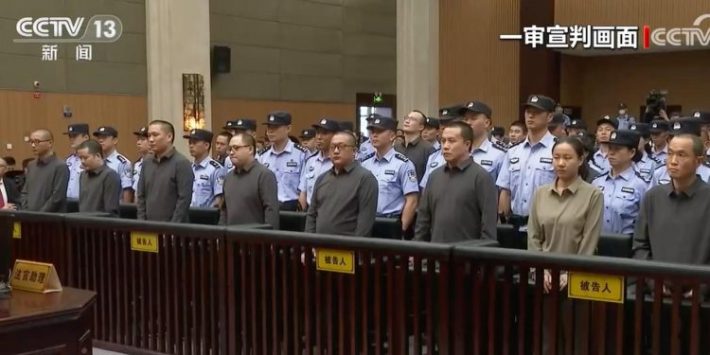
China has sent a signal to the thousands of its citizens operating scam centres in Southeast Asia, through its decision to execute 11 members of a notorious family and mafia figures that ran scam centres in northern Myanmar.
Members of the Ming family, one of several clans that were prominent in the self-governed region near the Chinese border, were executed for crimes that included “intentional homicide, intentional injury, illegal detention, fraud, and operating gambling establishments,” Xinhua reported today.
The Mings and numerous others received death terms in September 2025 after a trial in Wenzhou, in eastern Zhejiang province. They were one of a handful of clans that operated casinos and red-light zones before setting up scam centres in Laukkaing, a town near the Chinese border.
ALSO SEE: British PM Starmer Arrives in China, Seeking a Pickup in Trade
The 11 “gang members” appealed the initial verdict to a Higher People’s Court, but it confirmed the original outcome, and a Supreme People’s Court (SPC) later endorsed the death sentences, Xinhua said.
The SPC said the 11 ran multiple bases in Myanmar to engage in telecom fraud, illegal gambling dens and committed other crimes. It said the funds involved in fraud and gambling exceeded 10 billion yuan (about $1.4 billion).
“The gangs also intentionally murdered, assaulted, and illegally detained people involved in fraud, resulting in the deaths of 14 Chinese citizens and causing injuries to others.”
The outcome was widely anticipated after China’s robust intervention to shut down scam centres in Laukkaing in the Kokang self-administered zone in late 2023.
More executions expected
Analysts have speculated that it could be the first of many such verdicts emerging from courts on the mainland, because Beijing wants people involved in fraud operations in Southeast Asia to know they face the ultimate punishment for such crimes.
Scam centres in Myanmar, Cambodia and Laos have been reaping vast sums in recent years and causing severe trauma for people trafficked and forced to work in such compounds, as well as victims swindled out of their savings.
Chinese criminals are suspected to run many of the centres but experts monitoring the ‘scamdemic’ say people have been drawn from all over the world to work in such places and many do so voluntarily because of the lack of work opportunities in their home countries.
Recently, leaders in both Myanmar and Cambodia have been demolishing scam compounds, but experts such as Jacob Sims, Jason Tower and others have suggested these have usually been stunts to try to show powerbrokers in China and the US that they are cracking down on the problem.
China’s Public Security Ministry said over 7,600 Chinese nationals accused of online gambling and telecom fraud were repatriated from Myawaddy, a town on Myanmar’s southeastern border with Thailand, in 2025.
And many hundreds more have been flown home from Mae Sot in northwestern Thailand in recent weeks after the demolition of scam compounds such as KK Park.
‘Bai family are next’
Harvard researcher Jacob Sims, who compiled a troubling report about the extent of scam operations in Cambodia last year, posted a video of the court verdict on X and said: “This is the first time China has put Myanmar-based scam bosses to death.”
He predicted that another notorious clan from Laukkaing could get the same fate, saying: “Five more from the Bai family are next. Trials for the Wei and Liu clans are still ongoing.”
The Bai family is another clan from Laukkaing arrested and handed over to Chinese authorities after the crackdown in late 2023.
“The scam industry hasn’t disappeared. It’s just moved south,” Sims said. “The question now is whether anyone in Cambodia or along the Thai border is paying attention.”
Meanwhile, US and British authorities have also been doing their bit to target the heads of scam centres in Southeast Asia.
Their most prominent action was imposing sanctions on the Prince Group in Cambodia and seizing about $15 billion worth of bitcoin, plus properties worth $172 million in Britain last October.
That intervention led to Chinese police arresting Prince Group chairman and alleged ‘scam billionaire’ Chen Zhi earlier this month.
He could face a similar fate, depending on how the cards fall in coming years.
- Jim Pollard
ALSO SEE:
‘Scam Billionaire’ Chen Zhi Arrested in Cambodia, Flown to China
States Seize $700m Prince Group Assets Amid Hunt for ‘Scam Billionaire’
US Targets Billion-Dollar Scam Networks in Myanmar, Cambodia
US, UK Lauded for Scam Centre Sanctions, $15bn Bitcoin Seizure
Cambodian Scam Centres Straining Ties With States Near And Far
US Sanctions Karen Warlord, Cambodia ‘Money Laundering Group’
SE Asia Crime Networks Rely on Telegram, Crypto, UN Says