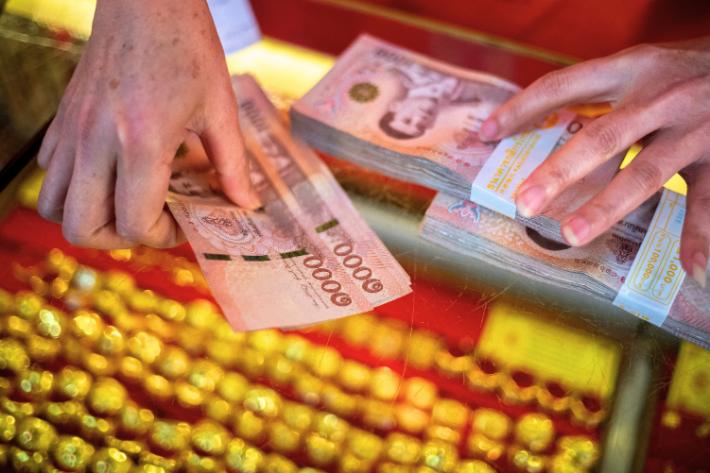
The surging price of gold continues to trouble Thailand’s top economic officials, after soaring to a five-year high this week.
Meanwhile, citizens are wondering if a massive wave of ‘grey money’ – from scam centres in neighbouring countries – will impact the outcome of the election early next month.
On Wednesday, the Thai baht shot up past 31 to the US dollar, as the price of gold reached $4,800 an ounce. And it was still trading above that mark late on Friday.
ALSO SEE: Half of Global C02 Emissions Come From 32 Companies: Report
Thailand’s top economic officials have been alarmed by the strength of their currency, which Finance Minister Ekniti Nitithanprapas described this week as a “very big concern.”
The minister was in Davos attending the World Economic Forum on Wednesday, where he was interviewed by Bloomberg TV. “Thailand is a small, open economy and we’re a net-export country, so baht appreciation affects our economy,” Ekniti said.
He explained that every one-baht gain against the greenback shaves about 0.1 to 0.2 of a percentage point off Thailand’s gross domestic product growth, which he expects to expand by about 2% this year.
Ekniti said the baht’s rise stems from the weaker US dollar, the country’s large current account surplus and what he called “speculative flows.”
‘Grey money’
The latter somewhat vague term covers money flowing into Thailand and includes money used to buy gold, or invested in online gold trading, which has been a worry for much more than just the impact these inflows have on the Thai economy.
That’s because Thailand is currently the hub of a region immersed in a serious level of transnational crime and suspicion that the plethora of criminal gangs involved in scam centres in Myanmar, Cambodia and Laos – as well as drug production and trafficking – have been laundering money in Bangkok; perhaps even investing their ‘grey money’ in gold, which would hardly be surprising given the way it’s been rising.
Those concerns were aired in Bangkok early this month by a senior UN official who noted that the Thai capital is also the banking centre of the Mekong region. The sums of money being reaped by scam centre operators in Cambodia and Myanmar are substantial, reportedly many billions of dollars a year.
Ekniti and the Bank of Thailand (BoT) have been doing what they can to rein in the currency, but central bank officials have conceded that their efforts have had limited impact to date.
He said officials are trying to ease these pressures by boosting foreign investment and curbing speculative activity linked to gold trading.
Central bank may target gold trading
The Bank of Thailand is set to unveil new rules for online trading of baht-denominated gold next week, on January 29, to counteract its impact on the currency.
Central bank Governor Vitai Ratanakorn said this week the strength of the baht “is primarily influenced by a surge in gold prices.”
He told reporters in Bangkok on Wednesday its intervention in the foreign exchange market had minimal impact, because of the market’s size and the limits of its influence offshore. “We don’t have enough power to set the baht level, to make baht weaken like others want,” he was quoted as saying.
The Thai baht gained about 8% last year as dollar weakness and gold’s remarkable 65% surge to a flurry of record highs helped offset weak domestic economic data.
But BoT officials have warned they could impose a punitive tax and undertake greater scrutiny of bullion trading because the strong baht is hurting two of its most important sectors – tourism and exports. And exporters want the baht at 33 to the dollar.
Investors are buying more gold because geopolitical tensions have soared recently, spurred by US intervention in Venezuela and trade tensions between Washington and Europe over Greenland early this week. The price of gold was over $4,952 at the time of writing in Bangkok at 10pm on Friday.
A big election issue
Thailand was one of a handful of countries in East Asia – along with Hong Kong, Singapore, South Korea and Taiwan – that took action to freeze assets totalling nearly $700 million suspected to belong to Chen Zhi, the alleged ‘scam billionaire’ who headed the Prince Group in Cambodia before he was flown back to China early this month to face a major police investigation.

And the Thais have also been cooperating with Chinese police, who flew hundreds of suspected scammers back to the mainland this week from the border town of Mae Sot, which critics say is awash with a deluge of illicit cash from over the border in Myanmar.
Pressure from China and the US has seen further ‘crackdowns’ in both Cambodia and the Myanmar border enclaves adjacent to Thailand, although there is widespread suspicion that these are just for show.
Indeed, a photo emerged on social media on Friday showing two Cambodian tycoons whose casinos, which were suspected to have been scam compounds, were allegedly destroyed by Thai shelling during the border clash in December. It showed them attending a religious ceremony for the new Senate building, which was reportedly presided over by Senate President Hun Sen.
That suggests business as usual in Phnom Penh.
And perhaps not surprisingly, the influx of ‘grey money’ has become a key issue in the run-up to the Thai election in two weeks’ time, with several parties declaring a strong stance, saying they will not form government with parties suspected to be linked to scam centres or criminal activities in neighbouring states.
Senior political candidates with the Rak Chart Party said they had “intelligence” claiming huge amounts of ‘grey money’ – up to 200 billion baht ($6.4 billion) – are circulating to buy votes in the February 8 election.
It could be another wild and rocky poll in the ‘Land of Smiles’.
- Jim Pollard
ALSO SEE:
Cybercrimes Now Reaping Trillions of Dollars a Year, UNODC Says
‘Scam Billionaire’ Chen Zhi Arrested in Cambodia, Flown to China
States Seize $700m Prince Group Assets Amid Hunt for ‘Scam Billionaire’
US, UK Lauded for Scam Centre Sanctions, $15bn Bitcoin Seizure
US Targets Billion-Dollar Scam Networks in Myanmar, Cambodia
Cambodian Scam Centres Straining Ties With States Near And Far
US Sanctions Karen Warlord, Cambodia ‘Money Laundering Group’
Cyber Scam Hubs Spread From Asia Like a Global Cancer: UN
Weak ASEAN Nations ‘at Risk of Evolving Into Scamming States’
N Korean Hackers Used Cambodian Firm to Launder Stolen Crypto
Scamming Compounds in SE Asia Stole $64 Billion in 2023: Report