Indian equities and currency, the rupee, saw their best day in months on Tuesday after US President Donald Trump made a surprise announcement overnight of a deal that would steeply cut trade tariffs on New Delhi.
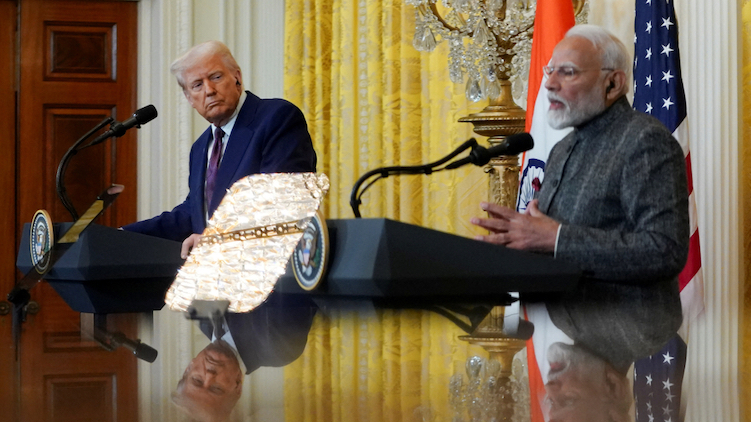
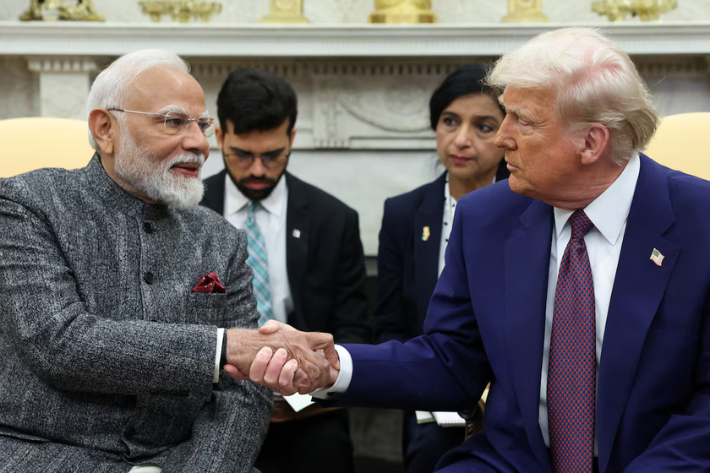
Trump announced the deal on his social media platform Truth Social on Monday following a call with Indian Prime Minister Narendra Modi.
He said the tariffs on India will immediately reduce to 18% — from a steep 50% — noting that the country would now buy oil from the US and potentially Venezuela.
Also on AF: India’s 20-Year Tax Break For Data Centres Faces Resource Crunch
The announcement lifted sentiment across Indian markets and among exporters and policymakers even as details of the agreement remained scant.
Indian shares posted their best day in nine months, led by oil giant Reliance and heavyweight financials. Export-oriented stocks also powered a broad rally after the trade deal removed a key market overhang.
Both Indian benchmarks surged about 5% in early trade. At close, the Nifty 50 settled 2.55% higher at 25,727.55 points, while the BSE Sensex gained 2.54% to 83,739.13, logging their strongest single-session rise since May 2025.
Mukesh Ambani-led Reliance jumped 3.4% after being battered in recent days as tensions persisted over the company’s huge purchases of discounted Russian oil since sanctions began on Moscow in 2022. Reliance is India’s largest private sector oil refiner and had earned $6 billion in profits from importing discounted Russian oil, the Financial Times reported last year.
The US-India trade deal spurs expectations that foreign fund inflows to Indian assets will pick up after sustained outflows over the last year.
The delay in the deal, lack of exposure to emerging themes such as artificial intelligence and muted earnings were key reasons for the foreign selling in Indian stocks since the start of 2025.
Foreign portfolio investors have offloaded about $23 billion worth of Indian shares in that time, triggering a rare underperformance compared with Asian and emerging market peers.
“The trade deal announcement does change the immediate outlook on India and sets a positive tone, which is good for equities in the short to medium term,” said Vineet Arora, managing director at NAV Capital Emerging Star fund, a Singapore-based foreign investor.
Relief for the rupee
Aside from Indian equities, the country’s beaten-down currency also made big gains on Tuesday. The Indian rupee logged its best day in seven years after the deal boosted market sentiment and spurred traders to unwind speculative wagers against the currency.
The rupee ended the day up 1.36% to 90.2650 per dollar, its best one-day gain since December 2018. The rally came days after the rupee hit a record low of 91.9875, pressured by firms’ hedging their dollar exposure and amid concerns over foreign outflows.
“Price-action in the NDF [non-deliverable forwards] market pointed to unwinding of some long (USD/INR) positions and the spot market was also influenced by likely inflows into local stocks,” a trader at a foreign bank told Reuters. NDFs let traders bet on the rupee without owning it.
“Higher tariffs on Indian goods had raised a balance-of-payments risk, contributing to rupee depreciation and triggering foreign outflows in a self-feeding cycle,” Peeyush Mittal, portfolio manager at Matthews Asia, said. The trade deal should break the loop and lend stability to rupee and stocks, he added.
Indicators of the rupee’s outlook also improved. Meanwhile, analysts at MUFG lowered their USD/INR forecast to 89.50 by the end of March 2026, from 91.50, and to 93 by end-2026, down from 94 previously.
Scant details on deal
Still, while the markets look optimistic, the deal’s fine print is thin.
India’s promise to halt Russian oil purchases is the key driver of the sharp cut in Washington’s prior tariffs on New Delhi. It means that the US will remove an additional 25% tariff it imposed on India to penalise Russian oil purchases.
Effectively, Indian exports to the US will now only face an additional reciprocal tariff, which Trump lowered to 18% from the prior 25%.
But US president’s social media post was not followed by details of the deal from the White House or the Indian government. A subsequent post on X from Indian Prime Minister Narendra Modi, announcing the deal, included no details either.
Wonderful to speak with my dear friend President Trump today. Delighted that Made in India products will now have a reduced tariff of 18%. Big thanks to President Trump on behalf of the 1.4 billion people of India for this wonderful announcement.
When two large economies and the…
— Narendra Modi (@narendramodi) February 2, 2026
An Indian government official told Reuters, however, that India had agreed to buy petroleum, defence goods and aircraft from the US, while partly opening up its guarded agriculture sector under the agreement.
US Agriculture Secretary Brooke Rollins also said on social media that the India-US trade deal will ensure more exports of American farm products to India’s massive market. He gave no details.
In the past, India’s trade deals have excluded some sensitive farm and dairy items, as New Delhi maintains the need to protect millions of subsistence farmers.
Meanwhile, an Indian official told Reuters that New Delhi also lowered tariffs on imported cars to address Washington’s immediate demands. Another official said New Delhi agreed to give zero tariffs to industrial goods coming into the country from US.
Trump said, without giving a timeframe, that India would buy more US goods, with purchases rising to over $500 billion, including energy, coal, technology and agricultural products.
Indian trade officials said India would achieve that figure over five years.
India’s Trade Minister Piyush Goyal said late on Tuesday that the two countries would issue a joint statement “soon” after a “final understanding” of the deal was signed.
Calls for caution
India’s exports to the US rose 15.9% year-on-year to $85.5 billion in January-November, while imports stood at $46.1 billion, Indian government data showed.
Lower US tariffs on most Indian goods will reinvigorate exports to the US, Moody’s Ratings said in a statement.
Indian experts echoed that outlook. “Lower tariffs will not only improve price competitiveness but also help Indian exporters integrate more deeply into US supply chains,” SC Ralhan, president of the Federation of Indian Export Organisations, told Reuters.
But others suggested the need for caution until the workings of the deal became clear.
“The Truth Social post [by Trump] leaves major questions unanswered — what products are covered, what the timelines are, and whether India has really agreed to zero tariffs and zero non-tariff barriers, especially in sensitive areas like agriculture and regulated imports,” Ajay Srivastava of the Delhi-based Global Trade and Research Initiative (GTRI) think-tank told BBC News.
GTRI also noted that considering India’s current imports from the US remain below $50 billion, Trump’s claims that New Delhi will, over the coming years, increase those by more than ten times require clarity.
“Until there is a joint statement, negotiated text, and clarity on enforceability, this should be treated as a political signal — not a concluded trade deal. Caution, not celebration, is warranted,” Srivastava told the BBC.
How India will cut Russian oil imports remains unclear too.
Indian refiners will need a wind-down period to complete Russian oil deals before imports can be stopped, and the government hasn’t ordered such a halt yet, Reuters reported.
The Kremlin said it had seen no statements from India about halting purchases of Russian oil.
Moody’s said immediately stopping Russian oil imports could disrupt India’s economic growth.
It “could also tighten supply elsewhere, raise prices and pass through to higher inflation, given that India is one of the world’s largest oil importers,” Moody’s said.
Better rate than peers
Nevertheless, experts maintain that the lower rate will work in India’s favour.
“India’s tariff agreement with the US removes its earlier disadvantage versus peers,” Neelkanth Mishra, chief economist at Axis Bank, said.
The deal helps affected Indian gems and jewellery, leather, plastics, ceramics and auto components and non-tech foreign investment, he added.
Among Asian peers, US tariffs on goods from Indonesia stand at 19%, while the rate for Vietnam and Bangladesh is 20%.
India’s economic affairs secretary, Anuradha Thakur, said on Tuesday that the announcement of the trade deal reduced a great deal of global uncertainty.
That sentiment was reflected in global markets, which took the US-India trade deal, and a resumption of US nuclear talks with Iran, as a sign of easing geopolitical tensions.
The dollar index, which measures the greenback against a basket of currencies, was flat at 97.5 after a two-day 1.5% advance.
- Reuters, with additional editing and inputs from Vishakha Saxena
Also read:
Canada’s Carney Leads Trade Shift From US, to China, India, Australia
Giant EU-India Trade Deal Finalised, Modi Says
India ‘to Cut Tariffs’ on EU Cars in ‘Mother of All Trade Deals’
India ‘Could Face Higher Tariffs if Russian Oil Buying Continues’
How India’s Negotiations With The US on Trade Deal Broke Down
India’s US Exports Jump 22% in 2025
US Sanctions Force Indian, Chinese Refiners to Cut Russian Oil
How US Visa Hikes Can Benefit India
How Trump Lost The Plot, On India