Cambodia has continued its crackdown on scam compounds, with thousands arrested and hundreds deported on flights to their home nations in recent days.
However, given the scale of such criminal activity all across the country, experts monitoring the scam centres have serious doubts that the government is truly turning its back on such operations, given they have become Cambodia’s biggest industry and bring in an estimated 40% of gross national product (GDP).
Raids on scam compounds by police and immigration officials have been a semi-regular part of the government’s strategy to counter negative publicity about the industrial-scale fraud that has flourished in virtually every province since the Covid-19 pandemic, experts say.
ALSO SEE: Seoul Yet to Resolve Investment Dispute and Tariff Hike by US
However, the Cambodian regime is currently under significant pressure to act, given that China, the United States and many of its neighbours in Asia, along with major donors such as Japan, and countries whose citizens have died in such places (such as Korea), have been urging a major clean-up.
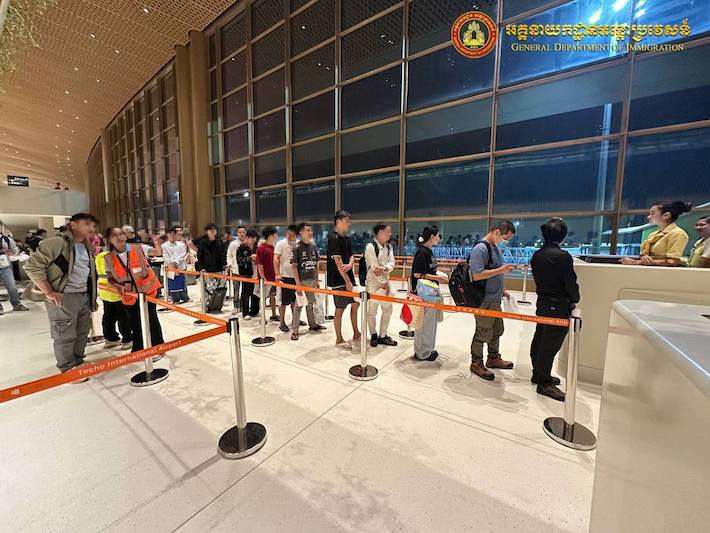
Some 406 foreigners from nine countries were deported from Techo International Airport in Phnom Penh on Monday, according to the General Department of Immigration, which posted photos (including the one above) of these people as they lined up for flights to leave the country.
It said they came from China, Indonesia, Bangladesh, Uganda, Nigeria, South Korea, India, Thailand and Sierra Leone. Chinese nationals made up the biggest proportion of the deportees on Monday, with 140 of that total, KiriPost said.
All but 28 of the 406 were men, and they can probably be counted as some of the lucky ones, given that thousands of others have been arrested or simply released from a range of compounds, often without money.
Many have struggled without cash, food, or identity documents (usually confiscated after they arrive) and have been sleeping rough in the open and unsure how they can get home.
Others have told local reporters they have been offered jobs in other scam centres, which have allegedly been saying they can continue such work and be “free” to come and go.
‘A humanitarian crisis’
Rights group Amnesty International estimates that thousands of people have been released or escaped from at least 17 scamming compounds across Cambodia in recent weeks. It said interviews with survivors had indicated that some were “subjected to grave abuses, including rape and torture.”
Those in most difficulty are from countries beyond the region, such as Brazil, Bangladesh, Nigeria and other parts of Africa, whose countries don’t have representatives in Phnom Penh or the funds to fly its citizens home, or simply a policy not to do so.
Amnesty has called out the Cambodian government for ignoring what it says is a growing humanitarian crisis.
“This mass exodus from scamming compounds has created a humanitarian crisis on the streets that is being ignored by the Cambodian government. Amid scenes of chaos and suffering, thousands of traumatised survivors are being left to fend for themselves with no state support,” Montse Ferrer, Amnesty International’s regional research director, said.
“This is an international crisis on Cambodian soil. Our researchers have met people from Asia, Africa, Europe, and the Americas. They are in urgent need of consular assistance in order to help get them home and out of harm’s way.”
On Saturday (Jan 31), more than 2,000 foreigners from nine countries were detained after a big raid staged in Bavet city in Svay Rieng province. Most were Chinese, local media said, likely desperate for work because of the country’s severe economic slowdown.
Some 59 Vietnamese were deported on that day, and there have been reports of many more being allowed to return to neighbouring countries.
The Indonesian Embassy released a statement on Saturday that said: “The number of Indonesians formerly involved with online scam syndicates who are reporting to the Indonesian Embassy in Phnom Penh continues to increase.
“Since January 16 to January 30, we have recorded 2,795 Indonesian nationals,” it said.
At least 36 Indonesian nationals were repatriated on Friday, while another 30 were due to return to Indonesia over the weekend.
Malaysia has also “rescued and repatriated” 29 of its citizens from Cambodia who were “victims of an online syndicate,” its embassy said last week.
The Philippine government also repatriated 13 Filipinos identified as human trafficking victims last Sunday, the Department of Migrant Workers in Manila said in a statement.
The latest raids follow the arrest of a Chinese tycoon last month, named Chen Zhi, who was extradited to China, after being sanctioned by the US and Britain in October.
The arrest of the ‘scam billionaire’ has put the spotlight on Cambodia and its ruling elite, who are said to be directly tied to some of the scam operations and reluctant to shut them down because of the enormous amounts of money they have brought in.
Last year, some 13,557 people were deported from Cambodia, according to the immigration department.
- Jim Pollard
ALSO SEE:
Members of Notorious Myanmar Scam Mafia Executed in China
‘Scam Billionaire’ Chen Zhi Arrested in Cambodia, Flown to China
States Seize $700m Prince Group Assets Amid Hunt for ‘Scam Billionaire’
US Targets Billion-Dollar Scam Networks in Myanmar, Cambodia
US, UK Lauded for Scam Centre Sanctions, $15bn Bitcoin Seizure
Cambodian Scam Centres Straining Ties With States Near And Far
US Sanctions Karen Warlord, Cambodia ‘Money Laundering Group’
SE Asia Crime Networks Rely on Telegram, Crypto, UN Says