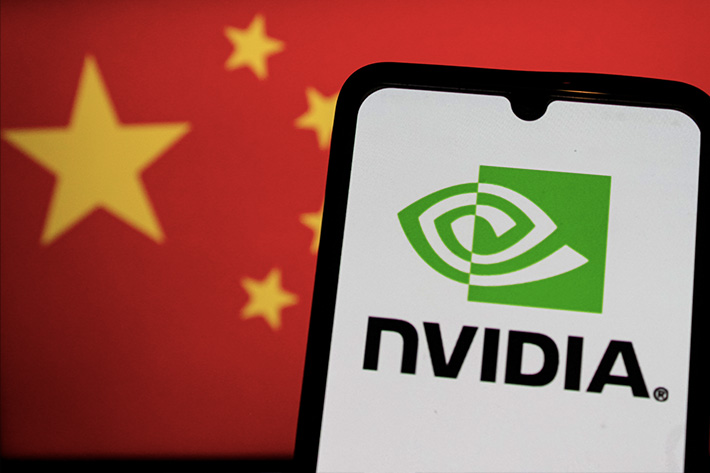
The Donald Trump administration has begun a process to review licences for shipping Nvidia’s H200 chips to China, sources with knowledge of the matter told Reuters.
The US Commerce Department, which oversees export policy, has sent license applications for the chip sales to the State, Energy and Defence Departments for review, the sources said.
Those agencies have 30 days to weigh in, according to export regulations.
Also on AF: China’s Big Tech Secret: Lab Copied Dutch Chipmaking Machine
One of the sources, an administration official, emphasised the review would be thorough and “not some perfunctory box we are checking.”
But under the regulations, the final decision rests with Trump.
A White House spokesperson did not comment on the review, but said “the Trump administration is committed to ensuring the dominance of the American tech stack – without compromising on national security.”
The review process, once complete, could result in the first shipments to China of Nvidia’s second-most powerful AI chips, making good on Trump’s pledge to allow the controversial sales.
Questions still remain, however, about how quickly the US might approve such sales and whether Beijing would allow Chinese firms to purchase the Nvidia chips.
Still, the move represents a departure from the policies of Trump’s predecessor Joe Biden, who imposed a raft of restrictions on sales of advanced AI chips to China.
It also marks a dramatic reversal from Trump’s first term, when he drew international attention by cracking down on Chinese access to US technology. Back then, he cited claims that Beijing steals American intellectual property and harnesses commercially obtained technology to bolster its military. Beijing denies the claim.
Significant opposition
The US government will collect a 25% fee on all H200 sales to China. Trump has also said the sales would help keep US firms ahead of Chinese chipmakers by cutting demand for chips made by the likes of Huawei and Cambricon.
But the move has drawn fire from China hawks across the US political spectrum over concerns the H200 would supercharge Beijing’s military and erode the US advantage in artificial intelligence.
Exporting large numbers of the chips to China would be “a significant strategic mistake,” said Chris McGuire, a former White House National Security Council official under President Joe Biden and senior fellow with the Council on Foreign Relations.
McGuire described the chips as “the one thing holding China back in AI.”
“I cannot possibly fathom how the departments of Commerce, State, Energy, and Defence could certify that exporting these chips to China is in the US national security interest,” he said.
Beijing’s response remains to be seen
Led by White House AI czar David Sacks, several members of the Trump administration now argue that shipping advanced AI chips to China discourages Chinese competitors like Huawei from redoubling efforts to catch up with Nvidia’s and AMD’s most-advanced chip designs.
Trump had previously opened the door to sales of a less-advanced version of Nvidia’s Blackwell chips, its cutting-edge offering, but backed away from the move and approved sales of the H200 instead.
Chinese demand for the H200, meanwhile, has outstripped Nvidia’s current capacity with TikTok parent ByteDance and internet giant Alibaba looking to place large orders for the chips. The H200 is more powerful than any of China’s current domestically-made chip offerings.
Beijing has held emergency meetings with its top technology firms to assess demand for the H200. Over the past three months Chinese officials have discouraged and even banned the country’s top technology firms from using Nvidia’s lower-tier H20 chip.
Experts say China will likely green-light H200 sales to remain competitive in the AI race, but continue to throw its weight behind domestic chip development. Beijing has also received proposals suggesting it require Chinese tech firms to bundle up any H200 purchases with those of domestic chips.
On Thursday, Chinese Commerce Minister Wang Wentao also met with US chipmaker AMD’s CEO Lisa Su in Beijing.
“The two sides exchanged views on the company’s business development in China and strengthening cooperation with China,” the Commerce ministry said in a statement released on Friday.
- Reuters, with additional editing and inputs from Vishakha Saxena
Also read:
China’s Bytedance Signs JV Deal on Operation of TikTok in US
US Lawmakers Move to Block Trump Easing China Chip Curbs
Bumper IPO by Another China Chip Firm Raises Hype Worry
China Firms Lobby For Nvidia’s H200 But Local Chips Remain
ByteDance, Alibaba ‘Looking to Place Big Orders’ For Nvidia’s H200
Nvidia’s Biggest Chinese Buyer Can No Longer Use Its Chips For AI
Powerful Nvidia Chip May Put Chinese Chipmakers in Choppy Waters
US ‘Likely To Delay’ Chip Tariffs To Keep China Ties Calm
China ‘Cutting Electricity Bills In Half’ For Its AI Chip Firms – FT
Chinese AI Firms, Chipmakers Form Alliance To Ditch Foreign Tech
China’s Huawei, SMIC ‘to Ramp Up Production’ of Newest AI Chip
Beijing And Its AI Billions