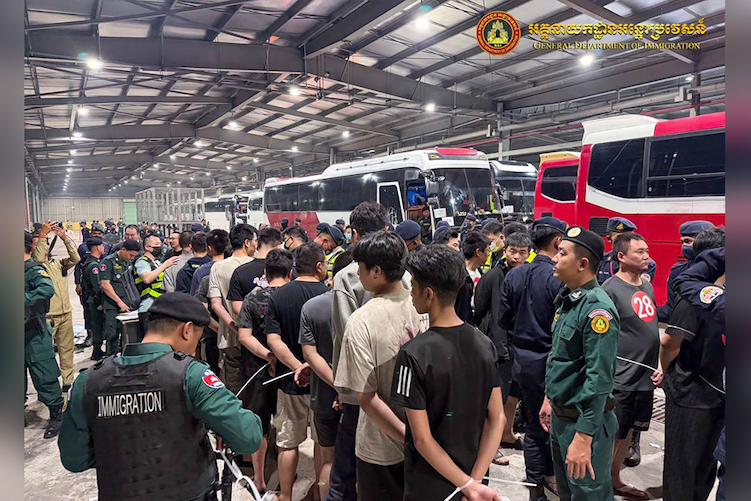
Thailand’s Anti-Money Laundering Office plans to confiscate assets totalling about 13 billion baht ($420 million), a large proportion of which appears to be linked to scam centre operations in Cambodia.
AMLO officials said on Wednesday they would get court orders to confiscate hundreds of assets – blocks of land, condos, vehicles, yachts, bank deposits and more – because the suspects, some of whom are Cambodian and their alleged associates in Thailand, could not prove the impounded assets were legally acquired.
The agency said there were four major cases involving multiple suspects. One involved the alleged scam billionaire Chen Zhi, who was arrested in Cambodia and flown back to China last month.
ALSO SEE: China, BRICS Nations Hedging Exposure to US Debt? – Fortune
AMLO said it found information “indicating a network involving online fraud, labour trafficking, and money laundering via digital currencies, linked to Chen Zhi”, who was the founder and chairman of Prince Group in Cambodia.
So, his case file was sent to prosecutors to petition a court for the seizure of 96 assets, including land, cash and other items worth about 345 million baht ($11.1 million).
Another case was linked to Cambodian senator Kok An, a casino tycoon known as the ‘Godfather of Poipet’, and associates, alleged to own compounds in the border town and Sihanoukville where scam operations were reported to have been undertaken.
That involved a request for prosecutors to petition a court for seizure of 89 assets – land and money in bank accounts totalling around 560 million baht (over $18 million).
Grey money from Cambodia?
But the bulk of the assets that AMLO seeks to seize are linked to a case involving Cambodian businessman Yim Leak, South African lobbyist and fixer Benjamin Mauerberger, also known as Ben Smith, and several associates.
AMLO alleges the money came from “defrauded victims,” and it has “information linking the case to Yim Leak. It also found transaction information linking to Ben Smith, with alleged conduct involving public fraud.”
Their case file was sent to prosecutors to petition the court for “forfeiture of 68 assets (including land, condominium units, vehicles, a yacht and money in bank deposit accounts), worth about 12,123 million baht” ($390 million).
Accusations in the second half of last year, by high-profile investigative reporters based outside Thailand that Mauerberger (Smith) had developed close ties with prominent Thai politicians over the past decade or more led to negative publicity for the Thai government and the resignation of one Cabinet minister.
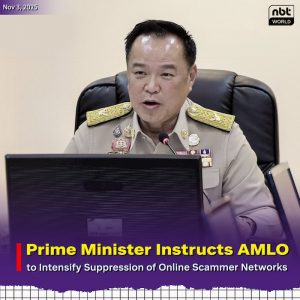
Prime Minister Anutin Charnvirakul, whose party won the election last Sunday and now has the biggest number of seats in the upcoming government, appears keen to eliminate any doubt about going soft on ‘grey money’ flowing into Thailand from neighbouring countries, assuring the public that he is committed to justice and will pursue operations against scammers and transnational crime.
And on Wednesday, he sought to live up to that pledge by endorsing AMLO’s announcement that financial seizures will proceed to the Thai courts.
Mauerberger, who is now believed to be in Dubai, has denied involvement in criminal activities. The whereabouts of his associates is not known.
A fourth case, listed as I Aung Sura and associates, involves a “scam group that allegedly persuaded members of the public to invest in coin mining via LINE groups.”
AMLO said that involved asking prosecutors to seize 31 assets (cash and money in bank accounts) worth about 46 million baht ($1.48 million).
On a positive note, AMLO said that “if there are victims in the offences in these cases, it will gather evidence under the law and forward the matter to prosecutors to ask the court to order that money or assets in the cases be returned or used to compensate victims, instead of being forfeited to the state.”
Cambodian ‘crackdown’ continues
Meanwhile, the Cambodian government’s high-profile ‘crackdown’ on scam centres continues. It claims to have raided nearly 200 scam compounds and that it wants to eliminate all such places by April.
The government has been under pressure from China, the United States and its neighbours in Southeast and North Asia to end the country’s notorious activities.
Prime Minister Hun Manet has vowed to ‘cut out rotten flesh,’ remove criminal officials and “expel evil from Cambodia.” But few believe that his father – Hun Sen, now leader of the Senate, who is still seen as the country’s most powerful leader – will allow him to turn off the money tap.
More than 5,500 foreigners suspected of working in scam centres or being victims of human trafficking were deported in 2025, and already this year, thousands more have been arrested and many hundreds put on planes to their home countries or are in the process of being sent home.
Hundreds more have been living rough on the streets of Phnom Penh and other provinces, despite serious efforts being made by some ASEAN nations to get their citizens home.
But foreign experts say they still have doubts on the ‘durability’ of the “national enforcement drive” and whether it will extend to action against members of the country’s elite involved in such activities.
Jacob Sims, a transnational crime analyst at Harvard University, said lasting change requires meaningful elite accountability and proper protection of trafficking victims and evidence.
“These deficiencies make the response look more like a cover-up than a sustainable and effective effort to stamp out the industry,” Sims told CamboJA News. He fears scam networks will reemerge once political and international pressure eases.
- Jim Pollard
ALSO SEE:
Thousands Arrested, 100s Deported After Cambodia Scam Raids
Members of Notorious Myanmar Scam Mafia Executed in China
‘Scam Billionaire’ Chen Zhi Arrested in Cambodia, Flown to China
States Seize $700m Prince Group Assets Amid Hunt for ‘Scam Billionaire’
US Targets Billion-Dollar Scam Networks in Myanmar, Cambodia
US, UK Lauded for Scam Centre Sanctions, $15bn Bitcoin Seizure
Cambodian Scam Centres Straining Ties With States Near And Far
US Sanctions Karen Warlord, Cambodia ‘Money Laundering Group’
SE Asia Crime Networks Rely on Telegram, Crypto, UN Says