Corruption purges in China have undermined the business dealings of the country’s biggest defence firms.
A study released on Monday by a leading conflict think tank found a drop in arms contracts and procurement last year.
The Chinese declines contrast with strong revenue growth globally for big arms and military services companies, fuelled by wars in Ukraine and Gaza, and global and regional tensions, research by the Stockholm International Peace Research Institute found.
ALSO SEE: Toll From Floods, Cyclones in Sri Lanka, Southeast Asia Tops 1,300
“A host of corruption allegations in Chinese arms procurement led to major arms contracts being postponed or cancelled in 2024,” Nan Tian, director of SIPRI’s Military Expenditure and Arms Production Programme, said.
“This deepens uncertainty around the status of China’s military modernisation efforts and when new capabilities will materialise.”
China military revenues down 10%, Japan’s up 40%
The People’s Liberation Army was one of the main targets of a broader corruption crackdown ordered by President Xi Jinping in 2012, reaching the upper levels of the military in 2023 when its Rocket Force was targeted.
Eight top generals were expelled from the ruling Communist Party on graft charges in October, including the country’s number two general, He Weidong. He had served under Xi on the Central Military Commission, China’s supreme military command organisation.
Asian and Western diplomats say they are still trying to gauge the impact of the crackdown on China’s ongoing military rise and how far down it reaches through the command chain.
Revenues of China’s top military firms fell 10% last year, while those in Japan surged 40%, Germany 36% and US revenues rose 3.8%, SIPRI data shows.
Long-term investment, modernisation ongoing
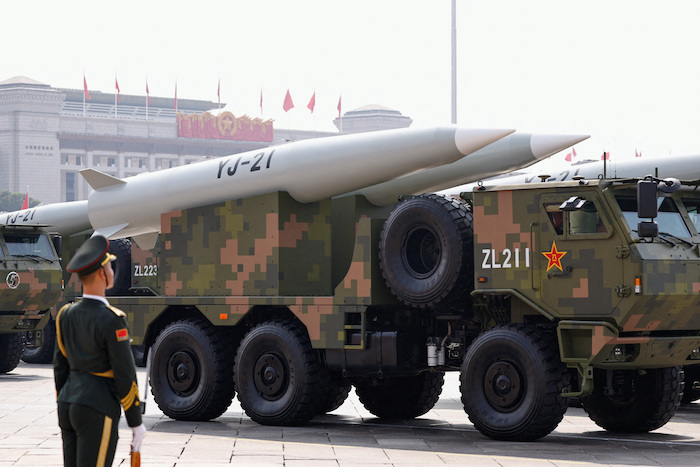
The buildup is bearing fruit as China deploys the world’s largest naval and coast guard fleets – including a potentially advanced new aircraft carrier – a host of new hypersonic missiles, nuclear weapons and air and sea drones.
Revenue fell at AVIC, China’s largest arms maker, land-systems producer Norinco and aerospace and missile manufacturer CASC, all state-owned, according to the SIPRI research.
Norinco experienced the steepest revenue decline, falling 31% to $14 billion.
Corruption-related personnel changes at the top of Norinco and CASC sparked government reviews and project delays, while deliveries of AVIC’s military aircraft slowed, the research found.
China’s defence ministry and the three companies did not immediately respond to faxed requests for comment from Reuters.
The timeline of advanced systems for the People’s Liberation Army’s Rocket Force, which handles its growing arsenal of ballistic, hypersonic and cruise missiles, could be exposed, along with aerospace and cyber programmes, SIPRI researcher Xiao Liang said.
This adds to uncertainties over the PLA’s target of getting key capabilities and war-fighting readiness in place for its 100th anniversary, Liang said. The PLA’s forerunner, Mao Zedong’s Red Army, was founded in 1927.
“However, in the medium and longer term, sustained investment in defence budgets and political commitment behind modernisation will continue, albeit with some programme delays, higher costs and tighter control of procurement,” Liang said.
- Reuters with additional editing by Jim Pollard
ALSO SEE:
China Ramps up Trade Pressure on Japan Over Taiwan Remark
China Deploys Biggest Naval Fleet in 30 Years, Taiwan Warns
China Hits US Military Firms With Sanctions For Taiwan Arms Sale
Chinese Military Scandal Seen Delaying Conflict in Taiwan, SC Sea
US, China Hold Informal Nuclear Talks, Discuss Taiwan
China Unveils Video of Simulated Invasion of Taiwan
Photos Emerge of China’s Military Bases on Artificial Islands
We Will Never Rule Out Using Force on Taiwan: Xi Jinping
Shipyard Image Exposes China’s Massive Naval Build-up