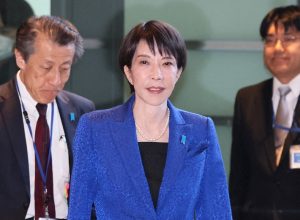
Japanese Prime Minister Sanae Takaichi is preparing to ramp up investment via public spending to revitalise the country’s meagre economic growth.
Official data revealed on Monday showed that the country’s economic growth fell short of market expectations, adding to pressure on Takaichi to stimulate activity after her recent election landslide.
Gross domestic product (GDP) in the world’s fourth-biggest economy expanded by just 0.1% in the fourth quarter, undershooting market forecasts of growth of 0.4%.
ALSO SEE: India’s New 3-Hour Content Takedown Demand ‘Impossible’: Experts
The growth follows a contraction of 0.7% – revised downwards from an earlier reading of minus 0.6% – in the previous quarter.
Growth in private consumption and private residential and corporate investments contributed to the expansion, according to the cabinet office data.
In calendar 2025, Japan’s economy grew 1.1%, after a 0.2% contraction in 2024, the data from the cabinet office showed.
On an annualized basis, GDP expanded by 0.2% in the three months through December, significantly weaker than the median economist estimate of 1.6% growth
Takaichi became Japan’s first woman prime minister in October and called snap elections for February 8. The vote saw her Liberal Democratic Party (LDP) win a historic two-thirds majority in the lower house.
Meeting with BOJ chief
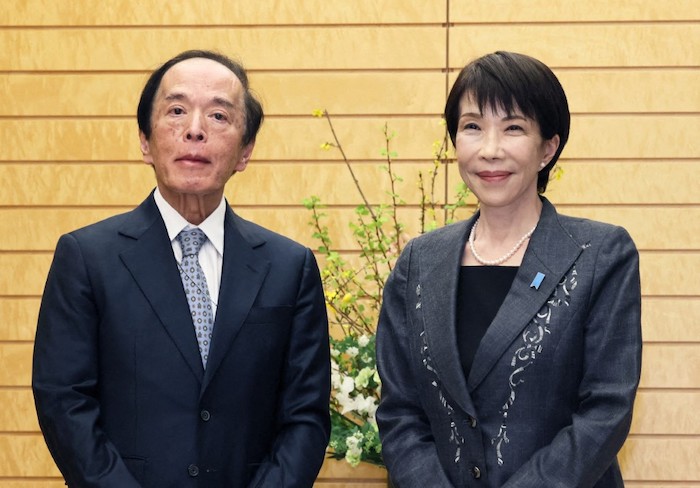
On Monday, she had her first meeting with Bank of Japan governor, Kazuo Ueda, since the election and may have discussed the central bank’s rate-hike plans.
There has been speculation that the central bank could raise interest rates as soon as March or April, because of the rising cost of living, stemming partly from the weak yen.
Ueda said later that he and the PM had a “general exchange of views on economic and financial developments” and that the prime minister did not make any specific monetary policy requests.
Asked if he was able to gain consent from the premier on the BOJ’s rate-hike stance, Ueda said: “There’s nothing in particular I can reveal on details of what was discussed.”
In November, Takaichi’s government pushed through a 21.3-trillion-yen ($139-billion) stimulus package aimed at boosting growth. It involved energy subsidies, cash handouts and investment incentives in key fields such as semiconductors and artificial intelligence.
It also included funds for expanded spending on defence, as China increases military activities in the wider region.
Takaichi’s big election win has heightened speculation that the PM might renew her calls for the BOJ to keep interest rates low.
Yen’s rebound
Some analysts have said the yen’s recent rebound may change the government’s view on the desirable pace of future rate hikes. After sliding close to the key 160 mark in January, the yen gained nearly 3% last week, which was its largest rise since late 2024. On Monday, the dollar was at 152.66 yen.
Investors, meanwhile, have been worried about Takaichi’s spending plans. That’s because Japan’s debts are more than twice the size of the country’s economy – the highest ratio among advanced economies.
Last month, yields on long-term Japanese bonds hit record highs after Takaichi pledged temporarily to exempt food from a consumption tax to ease the pain of inflation on households.
“The minuscule rebound in activity last quarter may embolden PM Takaichi to press ahead with even more fiscal loosening,” Marcel Thieliant at Capital Economics said on Monday.
The weak growth “implies that the large supplementary budget passed at the end of November provided no boost to public spending last quarter just yet,” Thieliant said in a note.
“In fact, sluggish economic activity increases the chances that Takaichi will not only press ahead with suspending the sales tax on food but enact a supplementary budget during the first half of the fiscal year that starts in April already, rather than wait until the end of this year,” he added.
But the country’s weak growth is not expected to deter the Bank of Japan from hiking interest rates later this year, economists say.
- AFP with additional input and editing by Jim Pollard
ALSO SEE:
Japanese Stocks Soar After Takaichi’s Landslide Poll Win
TSMC Says Second $17bn Plant in Japan Will Make 3nm Chips
Japan Claims ‘World First’ Retrieval of Rare Earths in Deepsea Drill
Japanese Bond Market Hammered by Takaichi’s Spending Vows
Japanese PM Takaichi to Call Feb 8 Poll on Spending, Defence
Japan Says China’s Dual-Use Export Ban is ‘Unacceptable’
China Ramps up Trade Pressure on Japan Over Taiwan Remark
Japan Signs Rare Earths, Nuclear Power Deal With Trump