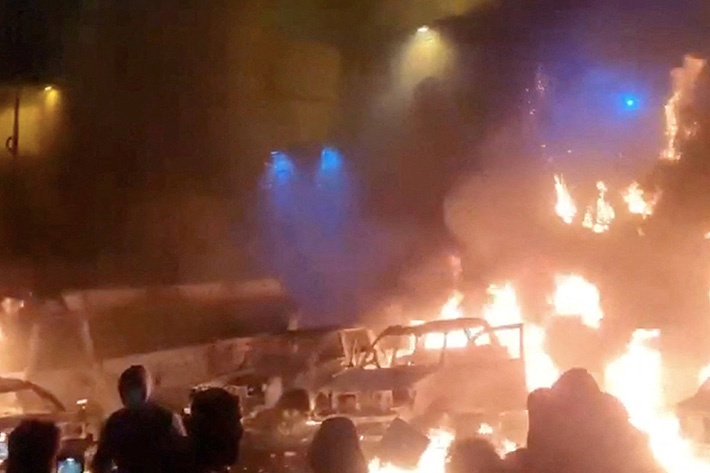
A rise in unrest in Iran on Friday led to government authorities shutting down the internet. Videos posted on social media had showed cars and buildings ablaze as anti-government riots raged in several cities.
The country’s ageing Supreme Leader, Ayatollah Ali Khamenei, has vowed not to back down. In an address shown on TV, he accused demonstrators of acting on behalf of émigré opposition groups and the United States, while rights groups reported police firing on protesters in the south.
Reuters said the unrest had not mobilised as many layers of society as other bouts of political, economic or human rights protest in the past decade and a half, but analysts say dozens have died and the conservative regime looks more vulnerable because of the dire economic situation after last year’s war with Israel and the United States.
ALSO SEE: Trump Says He’d be Very Unhappy if Xi Moves on Taiwan
While the initial protests were focused on the economy, with the Iranian currency, the rial, lost half its value against the dollar last year and inflation topping 40% in December, they have morphed to include slogans aimed directly at the authorities.
Buildings and cars ablaze
The internet blackout has sharply reduced the amount of information getting out, and phone calls to Iran were not getting through. At least 17 flights between Dubai and Iran were cancelled, Dubai Airport’s website showed.
Protests began late last month with shopkeepers and bazaar merchants demonstrating over inflation and the rial, but soon spread to universities and provincial cities, where young men were clashing with security forces.
Images published by state television overnight showed what it said were burning buses, cars and motorbikes as well as fires at underground railway stations and banks.
It blamed the unrest on the People’s Mujahedin Organisation, an opposition faction headquartered abroad that splintered off after the 1979 Islamic Revolution and is also known as the MKO.
A state TV journalist standing in front of fires on Shariati Street in the Caspian Sea port of Rasht said: “This looks like a war zone – all the shops have been destroyed.”
Videos verified by Reuters as having been taken in the capital Tehran showed hundreds of people marching. In one of the videos, a woman could be heard shouting “Death to Khamenei!”
The Iranian rights group Hengaw reported that a protest march after Friday prayers in Zahedan, where the Baluch minority predominates, had been met with gunfire that wounded several people.
Chief judge vows no leniency for rioters
Authorities have tried a dual approach – describing protests over the economy as legitimate, while condemning what they call violent rioters and cracking down with security forces.
The Supreme Leader, the ultimate authority in Iran, above the elected president and parliament, used tough language in a speech.
“The Islamic Republic came to power through the blood of hundreds of thousands of honourable people. It will not back down in the face of vandals,” he said, accusing those involved in unrest of seeking to please US President Donald Trump.
Judiciary head, Gholamhossein Mohseni Ejei, was quoted by state media as saying the punishment for rioters would be “decisive, maximal, and without legal leniency”.
Opposition fragmented
Iran’s fragmented external opposition factions called for more protests, and demonstrators have chanted slogans including “Death to the dictator!” and praising the monarchy that was overthrown in 1979.
Reza Pahlavi, exiled son of the late shah, told Iranians in a social media post: “The eyes of the world are upon you. Take to the streets.”
However, the extent of support inside Iran for the monarchy or for the MKO, the most vocal of émigré opposition groups, is disputed.
Trump, who bombed Iran last summer and warned Tehran last week that the US could come to the protesters’ aid, said on Friday he would not meet Pahlavi and was “not sure that it would be appropriate” to support him.
Germany condemned violence against protesters, saying the right to demonstrate and assemble must be guaranteed and media in Iran able to report freely.
- Reuters with additional editing by Jim Pollard
ALSO SEE:
‘Indonesian Oil’ Surging Into China May Come From Iran: Traders
India Wins Sanctions Waiver For Iran Port, US Keen For Deal
US Sanctions Force Indian, Chinese Refiners to Cut Russian Oil
Oil and Gas Firms, Governments Silent on Methane Leaks, UN Says
Oil Seen Topping $100 a Barrel if Iran Closes Strait of Hormuz
Chinese, UAE Firms Hit With US Sanctions Over Iran Oil Trading
Iran Wants New Currency for China Bloc With 30% of Global GDP