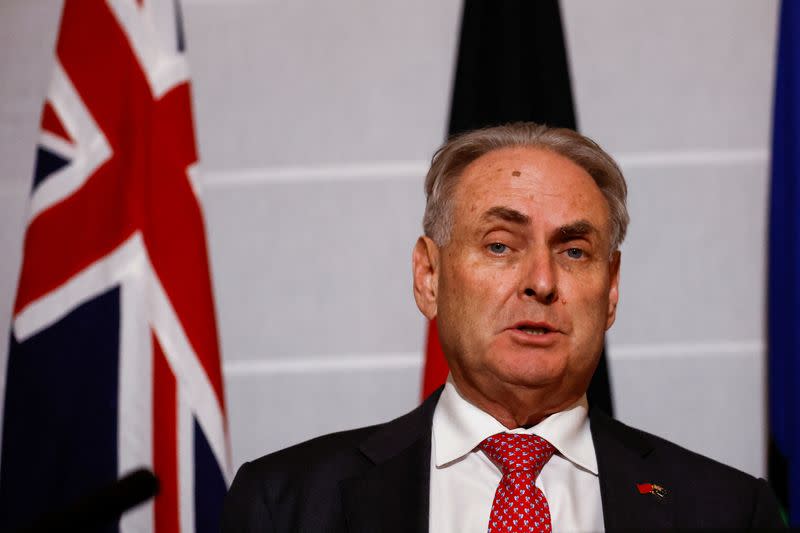
Australian Trade Minister Don Farrell will meet with his European counterpart Maros Sefcovic in Brussels next week in a bid to finalise a free-trade agreement between the two groups.
Australia is expected to allow more foreign investment and reduce the price of cars made in Europe in a comprehensive agreement that is also likely to lower tariffs for farm exporters.
The Australia-EU trade talks are among a flurry of deals that leaders in Europe, Canada, India and other countries have finalised because of the Trump Administration’s move to raise tariffs with trading partners in April last year.
ALSO SEE: Xi Urges Trump to be ‘Prudent’ in Dealings With Taiwan
The European Union is Australia’s third-biggest trading partner; bilateral dealings totalled just under $77 billion (A$110 billion) in 2024.
Recent negotiations are said to have resolved differences over naming rights for European products like prosecco and feta cheese, and will allow Australian producers who use those names.
Australia has also reportedly agreed to drop the 5% tariff on European cars, as a similar levy imposed on cars from Japan, South Korea, China, Thailand, the US and UK has been cut, while the luxury car tax on premium European models may also be eased.
But the final outcome will depend on whether EU negotiators accept Australia’s call for greater market access for beef and lamb — an issue which some of the EU’s 27 member states have refused to budge on to date.
If that issue can be resolved promptly, it could see European Commission President Ursula von der Leyen flying down to Australia later this month for “the unveiling of a deal that tightens the strategic alliance between the two sides,” the Sydney Morning Herald reported on Friday.
Farrell told Sky News last week: “We’re not far away. Some of the big issues, particularly the volume of Australian meat into the EU and the conditions surrounding that beef going into Europe, still remain unresolved. They’re the big issues.”
EU trade pacts with many states
On Tuesday, India finalised a massive trade deal with the European Union, its biggest trading partner.
That agreement will allow much greater trade between their two billion people, whose economies represent about a quarter of global business.
The EU-India deal came after close to two decades of on-and-off negotiations, which started in 2007. Trade between India and the EU totalled $136.5 billion in the fiscal year to March 2025.
It was the fifth pact that the EU has signed in the past year after similar agreements with the South American bloc Mercosur, plus Switzerland, Indonesia and Mexico.
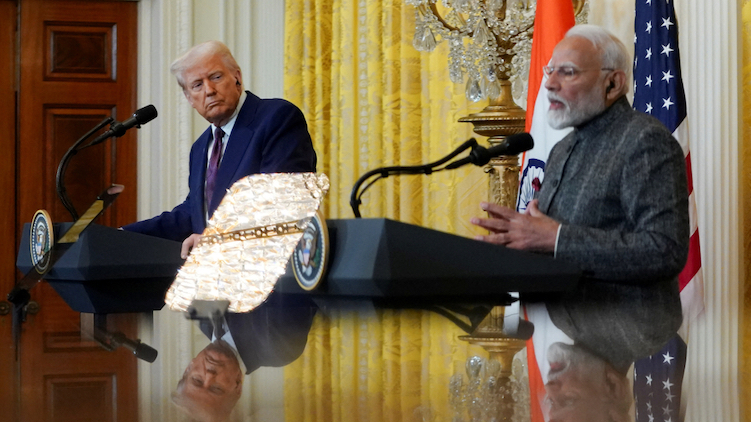
India has also signed trade pacts with Britain, New Zealand and Oman over the past year, spurred on by US President Donald Trump’s decision to impose a 50% tariff on goods and products from India.
That tariff has since been slashed to 18% after Trump announced a deal with Delhi three days ago. Officials from both sides are still believed to be tying up loose ends before full details are revealed to the public.
- Jim Pollard
ALSO SEE:
India Stocks, Rupee Soar on US Trade Deal Despite Few Details
Giant EU-India Trade Deal Finalised, Modi Says
India’s 20-Year Tax Break For Data Centres Faces Resource Crunch
Canada’s Carney Leads Trade Shift From US, to China, India, Australia
Giant EU-India Trade Deal Finalised, Modi Says
India ‘to Cut Tariffs’ on EU Cars in ‘Mother of All Trade Deals’
India ‘Could Face Higher Tariffs if Russian Oil Buying Continues’
How India’s Negotiations With The US on Trade Deal Broke Down