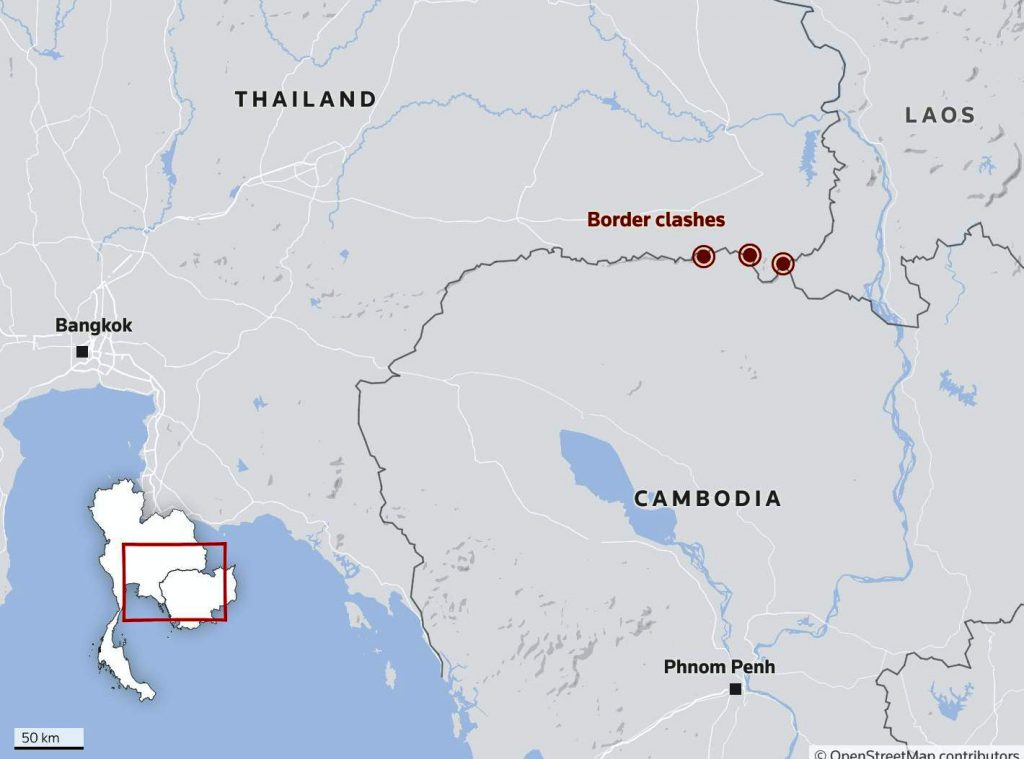
Clashes erupted on the Thai-Cambodian border again on Monday morning, following a rise in bilateral tensions over claims that Khmer troops had laid new landmines on part of the frontier.
Thai F-16 fighter jets bombed a Cambodian casino near Chong An Ma border pass in Ubon Ratchathani province and and a Cambodian cable car near Prasat Ta Khwai ruins in Surin province, according to Thai PBS news, “in retaliation for Cambodian bombardments of Thai military and civilian targets along the border.”
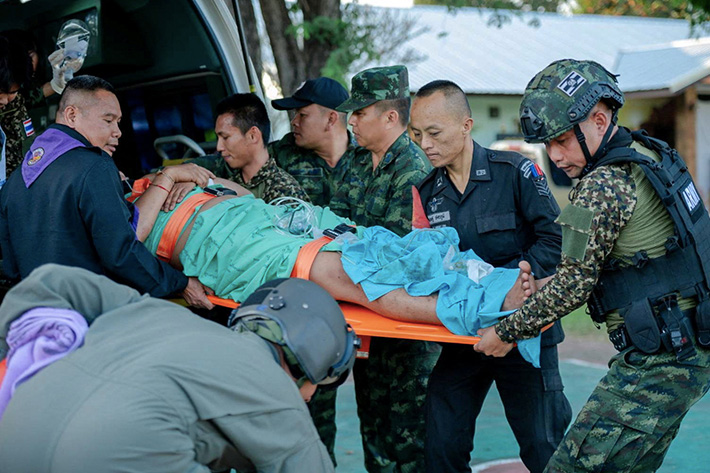
At least one Thai soldier was killed and eight wounded in the fresh clashes that intensified around 5am local time (2200 GMT), a Thai army spokesperson told Reuters. These locations are a long way from Bangkok and Phnom Penh, but tens of thousands of civilians living on both sides of the border had to be evacuated to safer locations.
ALSO SEE: China’s Desert Greening Projects Altering its Water Table: Study
Thai Army spokesman Maj Gen Winthai Suvaree told Thai PBS the casino has been used as a military base for drones, plus heavy weapons and munitions used to attack Thailand, while the cable car (which was destroyed) served Cambodian troops on Mount 350 seeking to prevent Thai troops from reclaiming the ruins.
Both countries accused the other of breaching a ceasefire brokered by US President Donald Trump after a five-day conflict erupted in July, before a ceasefire deal achieved by Malaysian Prime Minister Anwar Ibrahim and Trump, who witnessed the signing of an expanded peace agreement between the two countries in Kuala Lumpur in October.
Thailand’s Air Force said that Cambodia mobilised heavy weaponry, repositioned combat units and prepared support elements that could escalate military operations.
“These developments prompted the use of air power to deter and reduce Cambodia’s military capabilities,” it said in a statement.
Cambodia’s defence ministry said in a statement that the Thai military had launched dawn attacks on its forces at two locations, following days of provocative actions, and claimed that Cambodian troops had not responded.
Cambodia’s influential former longtime leader Hun Sen, father of current premier Hun Manet, said Thailand’s military was “aggressors” seeking to provoke a retaliatory response and urged Cambodian forces to exercise restraint.
“The red line for responding has already been set,” Hun Sen said on Facebook, without elaborating. “I urge commanders at all levels to educate all officers and soldiers accordingly.”
Three Cambodian civilians were seriously injured in the fighting so far, according to a senior provincial official. Cambodia’s defence ministry said its forces had not retaliated.
A diversion from scam centres?
Anwar, the current chair of the Association of Southeast Asian Nations (ASEAN) bloc, urged both sides to exercise maximum restraint and maintain open channels of communication.
“The renewed fighting risks unravelling the careful work that has gone into stabilising relations between the two neighbours,” Anwar said in a post on X.
Southeast Asian countries have rarely engaged in military clashes among themselves in recent decades, with the use of cross-border air strikes even rarer.
Reasons for the latest flare-up are not known yet. The Thai Ministry of Defence said Cambodia launched attacks on Sunday in an attempt to divert international attention from its “unacceptable use of landmines on Thai soil”.
Analysts have suggested that Phnom Penh may also be keen to divert attention from the scam centres operating in Cambodia.
The Thai Ministry of Defence posted a statement on its Facebook page on Monday evening saying evidence gathered by the Asean Observer Team in Thailand clearly showed that Cambodia had violated the Ottawa Convention by planting landmines across the border.
It said the evidence was presented at the 22nd Meeting of States Parties to the Ottawa Convention in Geneva. Cambodia is a signatory to the international treaty banning anti-personnel mines.
The ministry said the evidence included maps of where newly laid mines were found on Thai soil, physical traces of recent mine installation, the presence of PMN-2 anti-personnel mines, and patterns consistent with Cambodian military practice. Cambodia, it said, was unable to refute the findings with evidence or reason.
Border districts evacuated
Phichet Pholkoet, a resident of Thailand’s Ban Kruat district which adjoins Cambodia, said he has heard gunfire since early Monday morning.
“It startled me. The explosions were very clear. Boom boom!” he said via telephone. “I could hear everything clearly. Some are heavy artillery, some are small arms.”
In Thailand, more than 385,000 civilians across four border districts were being evacuated, with more than 35,000 already housed in temporary shelters, the Thai military said.
Across the border in Cambodia, opposition politician Meach Sovannara said civilians were also moving away from the fighting along the frontier.
“I heard the artillery shelling,” he told Reuters in an audio message from Samroang town, the capital of Oddar Meanchey Province, which abuts Thailand.
More than 1,100 families in Oddar Meanchey had been evacuated, authorities there said.
At least 48 people were killed and an estimated 300,000 temporarily displaced during the July clashes, with the neighbours exchanging rockets and heavy artillery fire for five days.
A long disputed border
Thailand and Cambodia have for more than a century contested sovereignty at undemarcated points along their 817-km (508-mile) land border, first mapped in 1907 by France when it ruled Cambodia as a colony.
The long-standing dispute has occasionally exploded into skirmishes, such as a week-long artillery exchange in 2011, despite attempts to peacefully resolve overlapping claims.
Tensions began rising in May this year, following the killing of a Cambodian soldier during a brief exchange of gunfire, and steadily escalated into diplomatic spats and armed clashes.
Anwar and Trump were able to halt the fighting within days and then cemented a ceasefire agreement at a regional summit in October. But last month Thailand said it was halting the implementation of the truce with Cambodia, after a landmine blast that maimed one of its soldiers.
Thailand has repeatedly accused Cambodia of planting fresh mines along parts of their border, which have seriously injured at least seven Thai soldiers since July.
Phnom Penh denies that. But some of the mines found along the frontier were likely newly laid, Reuters reported in October, based on expert analysis of material shared by Thailand’s military.
- Jim Pollard with Reuters
ALSO SEE:
Thai Police Seize $300m in Assets ‘Linked to Scam Centre Bosses’
US Offering Big Money to Nab Southeast Asian Scam Bosses
States Seize $700m Prince Group Assets Amid Hunt for ‘Scam Billionaire’
US, UK Lauded for Scam Centre Sanctions, $15bn Bitcoin Seizure
US Targets Billion-Dollar Scam Networks in Myanmar, Cambodia
Thailand, Cambodia Agree to Ceasefire After 5 Days of Clashes
Clashes Along Disputed Thai-Cambodian Border Claim 10 Lives
Thai PM Suspended; Court to Review Case Seeking Her Dismissal
Cambodian Scam Centres Straining Ties With States Near And Far
US Sanctions Karen Warlord, Cambodia ‘Money Laundering Group’
Cyber Scam Hubs Spread From Asia Like a Global Cancer: UN
Weak ASEAN Nations ‘at Risk of Evolving Into Scamming States’