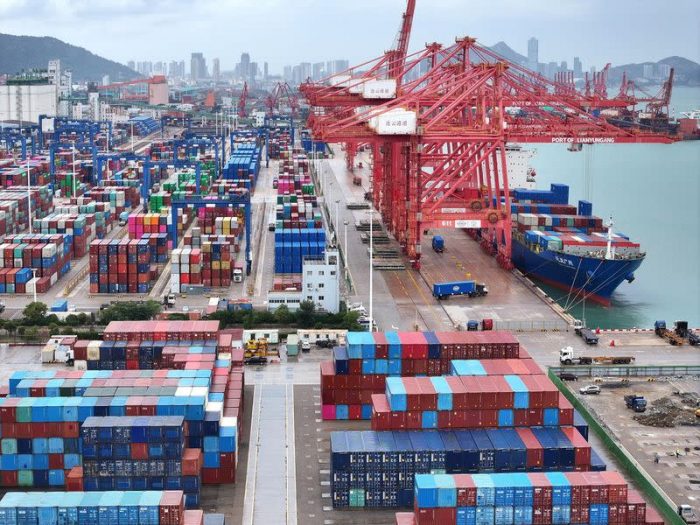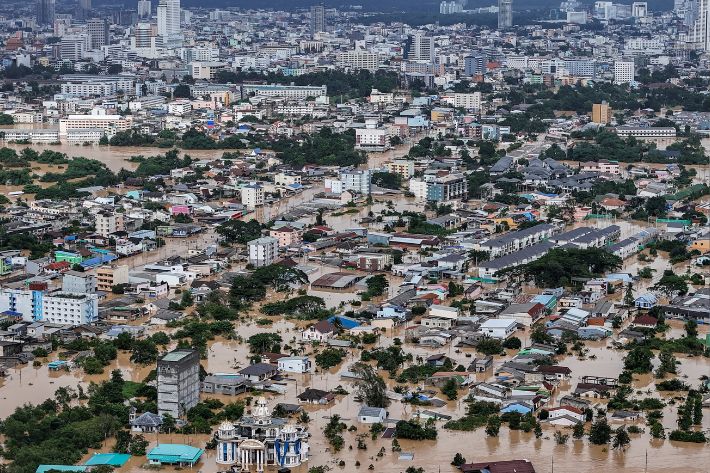
Countries in the Asia-Pacific will face estimated damage costs of more than $500 billion a year from coastal flooding if they are unable to adapt to rising sea levels, according to new research.
A report published in the Scientific Reports journal says coastal flooding is already severely affecting countries in Asia and the Pacific, causing costs of close to $27 billion every year across 29 countries in the region.
But it projects that the figure could rise to $518 billion by 2100 if policies to counter global warming aren’t greatly improved in the years ahead.
ALSO SEE: Thai Police Seize $300m in Assets ‘Linked to Scam Centre Bosses’
The latest study assesses models of coastal flood risk to evaluate permanent inundation from sea level rise and episodic flooding from extreme events across the region, and estimates costs and benefits of adaptation.
This is a big issue for both Asia and small island nations in the Pacific. Currently, Asia has more than 1.3 billion people living within 50km from the coast, which it said is about 40% of the world’s coastal population.
Over the past few weeks, Vietnam, Thailand, Indonesia and Sri Lanka have been hit hard by cyclones and extreme rainfall. Over 1,300 people have been killed and economic impacts were estimated this week at $20 billion.
For some of these countries, the world’s slow-moving environmental crisis is starting to get more real and worrying. But for others, like Bangladesh, Vietnam and the Philippines, which are regularly buffeted by cyclones, it began long ago.
The latest study says that even if high emissions are neutralised, “the legacy of previous emissions will ensure that sea levels continue to rise for at least a century.”
Researchers who worked on this study used projections from the Intergovernmental Panel on Climate Change’s sixth assessment report to model sea level rise over the 21st century, which includes meltwater from glaciers and ice sheets, but excludes “low-likelihood, high-impact” events such as ice-sheet collapse.
The authors assessed five future scenarios, ranging from a very low emissions pathway to a very high emissions scenario with “high fossil fuel reliance” throughout the 21st century.
They found that even under the lowest 1.5C warming scenario, countries in the Asia-Pacific would face damages of $338 billion due to coastal flooding every year by the end of the century, as noted by Carbon Brief.
In a high-emissions scenario, sea level rise could be as much as a metre. Small island states, such as Tuvalu, Kiribati, the Maldives and Micronesia, would lose around 10% of their land area, and a fair chunk of their GDP, despite having little responsibility for the causes of global warming.
Aside from those well-known threats, they said heightened vulnerability stems from factors such as heavily populated coastlines, low-lying deltas, and frequent typhoon exposure. “While Southeast Asia, South Asia, and East Asia face the highest monetary losses, the Pacific region suffers the most relative to its economic size,” the study says.
Huge annual costs
China and Indonesia “bear the largest share of expected annual flood damage, with each country facing over $6 billion in potential losses annually,” it said. India and Bangladesh were expected to face annual losses of $3.6 billion to $3.5 billion, respectively.
But “atoll nations” such as Vanuata, Micronesia and the Maldives faced the most severe risks, followed by Bangladesh.
The UN Environment Programme has estimated that the annual cost of adaptation by 2030 will range between $140–300 billion for 76 developing countries.
By 2050, the annual economic damage from coastal flooding across countries is projected to increase by between 4.4 and 6.4 times, with “median values between $143.7 and $197.8 billion,” the study projected.
By that time, some countries would need to spending more than 1% of GDP on adaption. Critical infrastructure such as ports and airports would need to be upgraded on islands and even cities such as Chittagong, Penang and Hong Kong. Coastal adaption costs would range from $9 to $18 billion.
By the end of the century, “rising sea levels are expected to cause significant and permanent loss of land in coastal areas, with estimates suggesting a loss of 4,652 to 11,150 square kilometres.”
China, Papua New Guinea, the Philippines, Bangladesh and Vietnam “will account for at least 60% of the total flooded land,” it said, while Kiribati, in the Pacific, would lose 10-20% of its total land area.
“Actual economic losses will be higher due to additional business interruption costs and other indirect effects of the economic shocks produced by the frequent floods,” it said, noting that other factors such as rivers and subsidence could compound risks in some cities.
Sea walls needed in some Asian cities
Tuvalu, Kiribati, the Maldives, Marshall Islands were susceptible to coastal erosion and inundation and would face the existential threat of disappearing entirely under rising sea levels. And the remoteness of some of islands posed additional limits on citizens’ capacity to adapt, because that could affect the availability of materials, technologies and costs.
The study said building sea walls, levees and embankments could greatly limit the economic damage from coastal flooding, as the money spent on such defences was much lower than the potential economic damage that sea level rise would cause.
This is an issue constantly being assessed in big cities across Asia, such as Bangkok, where there has been debate on greater development of the city’s 200 or so canals, so it can become like a modern-day “Venice of the East.”
But some academics say governments will also need to think about moving people away from the coast to higher ground.
- Jim Pollard
ALSO SEE:
Indonesians Blame Deforestation For Floods, Landslides; 700 Dead
Toll From Floods, Cyclones in Sri Lanka, Southeast Asia Tops 1,130
Waves of Record Rainfall Swamp Southern Thailand, Malaysia
Carbon Removal Credits in Short Supply As AI Firms Step Up Demand
EU To Reject India’s Demand For Carbon Tax Exemption
Climate Chaos ‘Could Disrupt Half of Global Chipmaking by 2050’
Asia’s Billion-Dollar Carbon Boom?
India’s Green Transition In A Chokehold
As Typhoons Lash Southeast Asia, COP30 Hunts Adaptation Finance