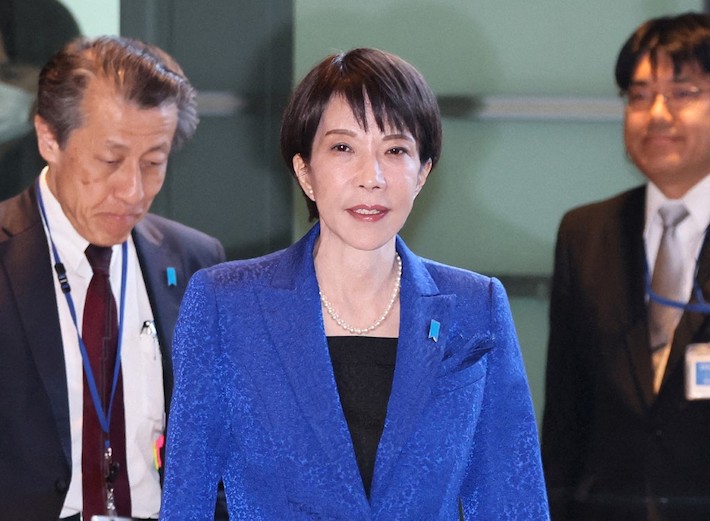
Stocks shot up 5% to record highs in Japan on Monday, after Prime Minister Sanae Takaichi’s Liberal Democratic Party won a landslide election victory on Sunday.
Takaichi’s LDP is expected to have a strong majority – two-thirds seats in the lower house of parliament (316 of the 465) – an outcome likely to put her in a powerful position over the next four years.
Her historic win has boosted the chances of her delivering tax cuts and spending plans, despite the fact her election promises – such as cutting the 8% food sales tax for two years – worry financial markets.
ALSO SEE: China, US Opt Out of Global Pledge on AI Use in Military Domain
Investors have been concerned because Japan has the highest debt burden in the developed world, and there has been uncertainty on whether it can afford such a move. Those doubts caused the yen to fall to historic lows and spurred a major selloff of government bonds.
But the initial reaction on Monday was a surge by the stock market, while bonds fell and the yen regained some ground, as the LDP victory should help the party to enact decisive stimulus measures.
The Nikkei shot up 5%, passing the 57,000 for the first time, before easing to 3.9% up, at 56,363.94 points, at the close of trading.
‘Heavy responsibility’
Takaichi said she felt a “heavy responsibility” to make the country more successful after the victory, according to Agence France-Presse.
“This is the start of a heavy, heavy responsibility to make Japan stronger, more prosperous,” Takaichi told a news conference.
Her agenda includes higher defence spending, potentially changing the constitution, and tougher immigration rules despite a falling population.
The region will be watching closely to see if she ups or lowers the temperature after enraging Beijing in November with comments about Taiwan.
Beijing warned Tokyo on Monday that reckless actions would be met with a “resolute response”.
After becoming Japan’s fifth premier in as many years in October, Takaichi capitalized on a honeymoon start by calling a snap election last month. It was a gamble that has paid off handsomely.
US President Donald Trump – who is due to host Takaichi next month – congratulated her after an earlier endorsement.
“I wish you Great Success in passing your Conservative, Peace Through Strength Agenda,” Trump wrote on Truth Social.
A heavy metal drummer in her youth, Takaichi was an admirer of Britain’s “Iron Lady” Margaret Thatcher, and on the ultra-conservative fringe of the LDP when she became party chief.
Despite being her country’s first woman premier, Takaichi has shown little appetite for framing her leadership around gender in male-dominated Japanese politics.
Popular, but will need to fix the economy
She has been a hit with voters, especially young ones, with fans lapping up everything from her handbag to her jamming to a K-pop song with South Korea’s president. But she will have to deliver on the economy to remain popular.
The LDP has governed Japan almost non-stop for decades, but shed support in recent elections because of unhappiness about rising prices and corruption.
Ryutaro Kono, chief Japan economist at BNP Paribas, said: “The election outcome has heightened the chance of a consumption tax cut,” although he noted that some members of her party have had reservations about the tax cut.
“The premier has repeatedly said past fiscal policy has been too tight. It’s clear she strongly favours overhauling fiscal policy from the current one driven by the finance ministry and fiscal experts within the LDP,” Kono said.
However, Takaichi said again on Sunday that she is keen to be a responsible fiscal manager and that she wanted “to build a strong and resilient economy.”
The food tax cut – which would cost about 5 trillion yen ($31.9 billion) a year – would only be temporary, she said.
The PM has hinted that she could tap non-tax revenues, such as Japan’s $1.4 trillion US Treasury holdings, although analysts believe she is unlikely to sell a large stake, given it would strain ties with Washington.
“In reality, the policies of a Takaichi administration are unlikely to curb the inflation that voters expect her to address,” Tetsuo Kotani at the Japan Institute of International Affairs told AFP.
“An income tax hike linked to increased defence spending will also be unavoidable. If these policies lead to a triple decline in stocks, the yen, and government bonds, people’s lives will become even more difficult,” Kotani said.
- Jim Pollard with AFP.
ALSO SEE:
TSMC Says Second $17bn Plant in Japan Will Make 3nm Chips
Japan Claims ‘World First’ Retrieval of Rare Earths in Deepsea Drill
Japanese Bond Market Hammered by Takaichi’s Spending Vows
Japanese PM Takaichi to Call Feb 8 Poll on Spending, Defence
Bets on Snap Election Push Japanese Stocks to Record High
Japan Says China’s Dual-Use Export Ban is ‘Unacceptable’
China Ramps up Trade Pressure on Japan Over Taiwan Remark
Japan Signs Rare Earths, Nuclear Power Deal With Trump