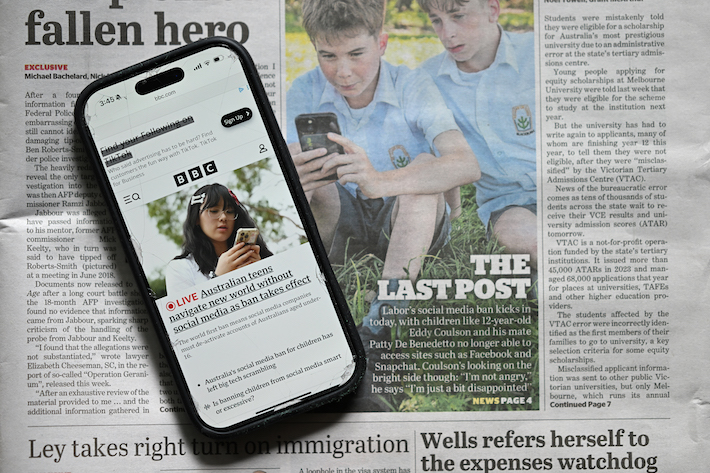
Australia – and its move to ban social media for children under 16 – was the focus of a lot of attention on Wednesday (Dec 10), the day the Albanese government launched its long-awaited move.
Initial reports about the outcome have focused on how numerous children were able to get around the ban, some with the help of their parents, others via tricking the photo assessment systems of different platforms, or just via VPNs.
But the government has, very sensibly, conceded that it will take time for its regulatory system to work and be fine-tuned.
ALSO SEE: US Fears China’s Genomics Giant BGI Could Surpass Huawei
Australia has been hailed as the first country to undertake such a ban, although China imposed major restrictions on youths accessing online gaming, the internet and social media several years ago (more on that below).
China is, of course, the world’s largest authoritarian state and has perhaps the most sophisticated mass surveillance systems to monitor its citizens. (They are now even using AI to extend their already intense levels of social control, CNN said last week – heaven forbid).
But in the free world, and far more normal nations, in Europe and Asia, regulators are closely watching to see how Australia’s restrictions go. So are the big tech giants most affected by the ban, of course, many of which criticised the move initially, but have been forced to comply.
Surveys have shown that the ban has been welcomed by a large proportion of parents and a range of other countries have said they hope to emulate the Aussie ban.
It began at midnight (1300 GMT) on Tuesday. Ten of the largest platforms – such as TikTok, Alphabet’s YouTube and Meta’s Instagram and Facebook – were ordered to block children or face fines of up to A$49.5 million ($33 million) under a law passed earlier this year.
Prime Minister Anthony Albanese said it “a proud day” for families and cast the law as proof that policymakers can curb online harms that have outpaced traditional safeguards.
“This will make an enormous difference. It is one of the biggest social and cultural changes that our nation has faced,” Albanese told a news conference on Wednesday.
“It’s a profound reform which will continue to reverberate around the world.”
In a video message, Albanese urged children to “start a new sport, new instrument, or read that book that has been sitting there for some time on your shelf,” ahead of Australia’s summer school break starting later this month.
TikTok shuts 200k accounts & more to come
Some of those below the cut-off age of 16 were anxious about adjusting to life without social media, but others were less concerned.
Clare Ni, 14, told Reuters: “I’m not really that emotional about it. I’m kind of just, like, neutral.”
Luna Dizon, 15, said she still had access to her TikTok, Instagram and Snapchat accounts, but worried about “culture shock” once the ban took full effect.
“I think eventually, without (social media), we’ll learn how to adapt to it,” she added.
Australia’s public broadcaster, ABC News, had some amusing responses from parents, two of which I’ll share here:
“My son opened TikTok this morning and received this message: ‘The social media ban has come into effect. Your age is estimated to be 18 years old.’ He is 11.” — David, in the state of Victoria.
And: “My 13-year-old daughter still has access to all her social media accounts this morning, and she verified her age via facial scanning. I am hoping that they are still working their way through and she will be booted off soon. If not, then it’s a fail for us.” — Alison, in the state of New South Wales.
So, clearly, it’s just the start of what could be a long process and a lot still depends on how the tech giants respond. (If you consider the way internet scams proliferate on social media, it hardly gives you confidence. So, the jury will be out for at least a few months).
But not all the news was negative. While the Australian government has said the ban would not be perfect in its operation, about 200,000 accounts were deactivated by Wednesday on TikTok alone, with “hundreds of thousands” more to be blocked in the next few days.
Many of the estimated 1 million children affected by the legislation also posted goodbye messages on social media.
“No more social media … no more contact with the rest of the world,” one teen wrote on TikTok.
“#seeyouwhenim16,” said another.
Global implications
The rollout caps a year of debate over whether any country could practically stop children from using platforms embedded in daily life, and begins a live test for governments worldwide frustrated that social media firms have been slow to implement harm-reduction measures.
Albanese’s centre-left government proposed the landmark law, citing research showing harms to mental health from the overuse of social media among young teens, including misinformation, bullying and harmful depictions of body image.
Several countries from Denmark to New Zealand to Malaysia have signalled they may study or copy Australia’s model, making the country a test case for how far governments can push age-gating without stifling speech or innovation.
Julie Inman Grant, the US-born eSafety Commissioner who is overseeing the ban, told Reuters on Wednesday that a groundswell of American parents wanted similar measures.
“I hear from the parents and the activists and everyday people in America, ‘We wish we had an eSafety commissioner like you in America, we wish we had a government that was going to put tween and teen safety before technology profits,'” she said in an interview at her office in Sydney.
X says it has to comply
Elon Musk’s X (formerly Twitter) was the last of the 10 major platforms to take measures to cut off access to underage teens after publicly acknowledging on Wednesday that it would comply.
“It’s not our choice – it’s what the Australian law requires,” X said on its website. “X automatically offboards anyone who does not meet our age requirements.”
Australia, meanwhile, has said the initial list of covered platforms will change as new products emerge and young users migrate.
Companies have told Canberra they will deploy a mix of age inference – estimating a user’s age from their behaviour – and age estimation based on a selfie, alongside checks that could include uploaded identification documents or linked bank account details.
For social media businesses, the implementation marks a new era of structural stagnation as user numbers flatline and time spent on platforms shrinks, studies show.
Platforms say they earn little from advertising to under-16s, but warn the ban disrupts a pipeline of future users. Just before the ban took effect, 86% of Australians aged eight to 15 used social media, the government said.
Some youngsters have warned the social media ban could isolate people.
“It’s going to be worse for queer people and people with niche interests, I guess, because that’s the only way they can find their community,” 14-year-old Annie Wang told Reuters ahead of the ban.
“Some people also use it to vent their feelings and talk to people to get help … So I feel like it’ll be fine for some people, but for some people it’ll worsen their mental health.”
China imposed controls four years ago
Chinese officials have probably been watching these developments with a smirk and wondering “What took you so long?”
That’s because China recognised – and moved to counter – the dangers of “internet addiction” and the negative effects of unfettered online access on youths four years ago.
It started in August 2021, when officials recommended strong restrictions – no more than three hours a week for online gaming, which was damned by state media as “digital opium” (dianzi yapian) or “spiritual opium”.
That criticism, which stemmed from newspaper reports that students were spending up to eight hours a day playing games such as ‘Honor of Kings’, caused shares of Tencent and Netease, two of the country’s biggest gaming giants, by plunge by 10% to 16%.
And in 2023, Cyberspace Administration of China (CAC) officials proposed strict regulations to limit children under 16’s use of the internet and social media.
The CAC said apps and devices should have a “minor mode” that allows parents to manage settings and content, plus limit daily usage, with children under eight allowed just 40 minutes a day; eight to 15-year-olds allowed an hour a day, and 16 and 17-year-olds permitted two hours a day.
It also urged a ‘night-time ban’ with children under 18 allowed no internet access from 10pm to 6am.
Strictly speaking, Beijing hasn’t imposed a complete social media ban for kids, but it has implemented legally-backed regulations and recommendations that function like bans, largely because its tech giants aren’t prepared to risk upsetting the regulator.
- Jim Pollard with Reuters
NOTE: The final paragraph was amended on Dec 10, 2025 to clarify China’s internet controls for children.
ALSO SEE:
Thai-Cambodian Border Clashes Flare Again After Row Over Mines
Thai Police Seize $300m in Assets ‘Linked to Scam Centre Bosses’
Big Tech to Freeze Australian Children’s Social Media Accounts
Software Trial Shows Australia’s Social Media Age Ban Could Work
Australian Law Bans Social Media for Children Under 16
TikTok Hit by US Legal Barrage For ‘Harmful’ Impacts on Kids
Nearly Half of Gen Z Wish TikTok Was Never Invented: US Poll
Big Tech ‘Doing Little’ to Counter Rampant Scams on Social Media
China Gaming Licences to Resume: 21st C Business Herald
China Gaming Shares Plunge as Beijing Tightens Regulatory Crackdown
Tencent Curbs Video Games After State Media Calls Them ‘Spiritual Opium’