A top US senator has identified a Chinese genomics company that he believes will emulate – and surpass – the achievements of Huawei, the Chinese telecom giant.
Senator Mark Warner, the most senior Democrat on the Senate Select Committee on Intelligence, fears that BGI, one of the world’s biggest genomics companies, has the capacity to dominate the genetic data sector in a manner that could create very troubling developments.
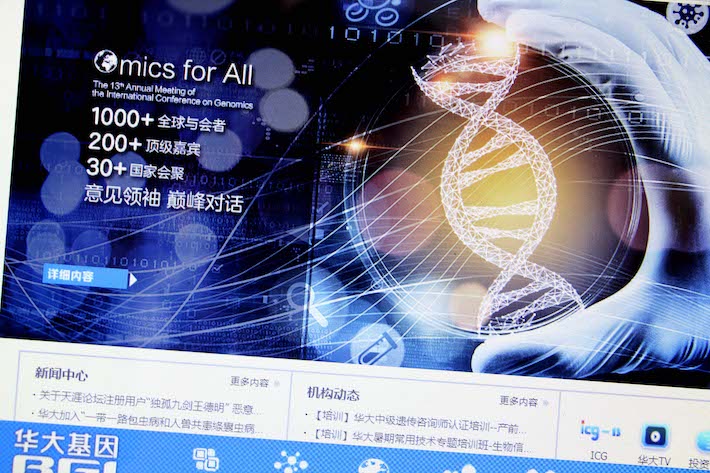
BGI collects DNA and runs sequencing laboratories through subsidiaries around the world that process genetic data for pharmaceutical companies, hospitals and researchers. Originally known as the Beijing Genomics Institute, it worked on national genome projects before becoming a global entity that does cancer screening, prenatal testing, DNA sequencing and large-scale genetic analysis.
ALSO SEE: China’s Desert Greening Projects Altering its Water Table: Study
BGI has helped create national genetic databases and systems that undertake tests that aim to prevent pandemics. But the genomics giant’s close ties with the Chinese Communist Party and the Chinese military have been a huge concern for Warner and US intelligence analysts for years.
They fear that BGI’s access to large collections of genetic data that can provide insights on people’s disease risks, physical traits and ancestry could be weaponised – used for biological research, surveillance or tracking; a “DNA arms race,” as the Washington Post called it.
That is why US Congress and Senate leaders had BGI blacklisted in 2021 and continue to issue public warnings about the potential abuse of BGI’s scientific work, because of the Chinese Communist Party’s firm control of all domestic firms and its obsession with state security.
Senator Warner aired his concerns about BGI at a business leaders’ event in Washington DC on December 3. CNBC quoted him as saying: “They hoovering up DNA data. This level of experimentation on humans and intellectual property theft, we all should be concerned about it.
“If Huawei was big, BGI will be even bigger,” Warner predicted.
One of the biggest fears about BGI and China’s biotech pursuits, it said, “is the possibility of a genetically enhanced soldier.”
That appears to stem from US officials who have claimed that China has explored enhancement of human performance and military biotechnology. CIA director John Ratcliffe, who has said that China aims to dominate “the planet economically, militarily and technologically,” also noted warnings by analysts about China’s collection of population DNA, military databases, and human performance modelling driven by AI.
Warner described such activity as “terrifying,” CNBC said, while noting that Huawei has risen on the back of huge state support and while the US moved to reduce Huawei’s global influence, it still managed to shape much of the 5G telecom ‘backbone’.
He worried that US intelligence operations have not paid enough attention to commercial tech sectors, and that the Trump Administration has undermined the sharing of intelligence from its allies and the US capacity to leverage the standards and protocols set for tech innovations.
China ‘increasing its lead in tech sectors’
Warner’s concerns could well have been amplified by the latest update on critical technology by the Australian Strategic Policy Institute. The ASPI’s Critical Technology Tracker report, on December 1, said:
“China’s exceptional gains in high-impact research are continuing, and the gap between it and the rest of the world is still widening. In eight of the 10 newly added technologies, China has a clear lead in its global share of high-impact research output.”
Chinese institutions had a substantial concentration of expertise in four areas rated as having a high tech monopoly risk, it said — cloud and edge computing, computer vision, generative AI and grid integration technologies.
The ASPI Technology Tracker now covers global research efforts into 74 technologies, 10 more than last year. This aims to give policymakers, industry and partners “the clearest, most current picture of the tech race for strategic advantage.”
It said the US had an early and often overwhelming lead in research on some of these new technologies in the early 2000s, but that was “eroded and then outmatched by persistent long-term Chinese investment in fundamental research.”
“China now leads in 66 of the 74 technologies tracked, with the United States leading in the remaining eight — an imbalance that underscores why trusted partners need to act together to leverage comparative advantages, reduce concentration risk and shape the trajectory of critical technologies together,” it said.
The European Union was still a “significant force,” the report said, “leading in high-impact research in four of the 74 technologies and breaking the US–China dominance.” Germany was among the top five countries in 30 technologies, while Italy and France were also noted.
The Chinese Academy of Sciences was still the world’s premier technological research institution, it said, ranking first in 31 technologies. It had lost the top spot in ‘quantum sensors’ and ‘novel antibiotics and antivirals’ to other Chinese universities, but ranked first in two of the 10 new technologies. Tsinghua University in Beijing was ranked top in five technologies.
Meanwhile, South Korea ranked in the top five in 32 technologies, while Japan had slipped slightly and is now in the top five in four technologies, the report said. India had also achieved significant momentum, ranking in the top five countries for research in 50 technologies (up from 43 last year), it said.
One of the new additions to the ASPI tech tracker is brain-computer interfaces (BCIs), which are technologies that create a direct communication link between the brain and an external device, “translating intention into action.” That sector is “accelerating rapidly,” the report said, “with commercial devices expected on the market as early as 2030.”
- Jim Pollard
ALSO SEE:
China Chip Designer Moore Threads Soars 500% in Shanghai IPO
China Curbs Rare Earth Exports to Defence Firms, Chipmakers
China’s ‘Tech Economy’ Outshining Its Cloudy Growth Outlook
Trump Unveils Pharma, Truck, Furniture Tariffs: Asia Stocks Fall
AI Data Centres Spark Fears on Memory Storage Devices – TH
Revised Bill Gives US Firms Time to Cut Ties With China Biotechs
US Adds 28 Chinese Firms, 10 Others to Trade Blacklist
China Drone Maker, Genomics Firm, Others Added to US Blacklist