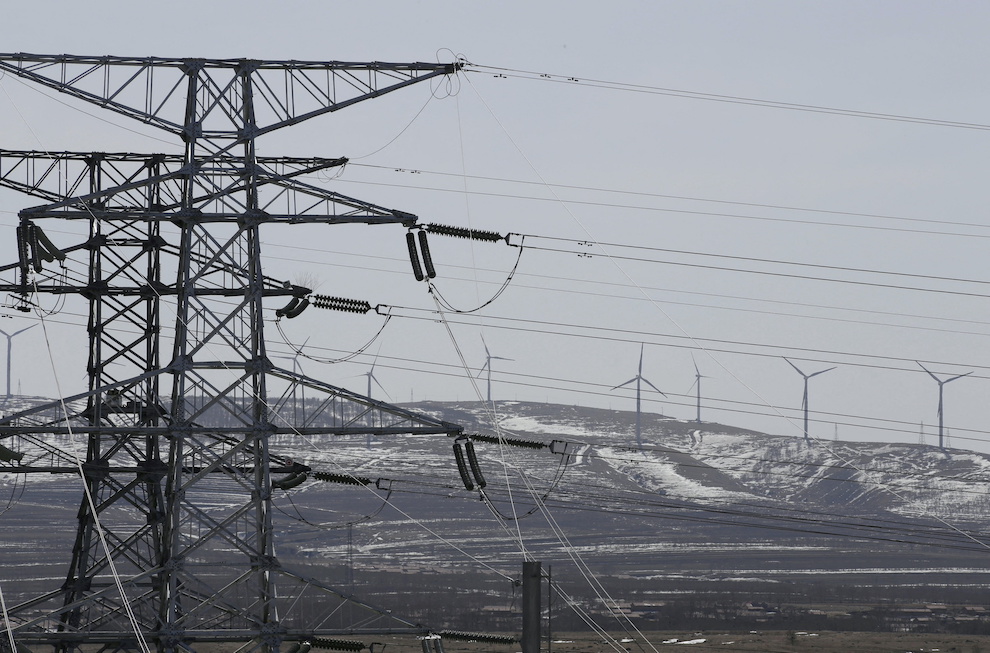
Beijing plans to spend 4 trillion yuan ($574 billion) by the end of the decade to upgrade its power grids as it races to meet renewables targets and looks to build data centre capacity, Chinese state-run Xinhua news agency said on Thursday.
China’s State Grid will make the investments between 2026 and 2030, Xinhua said, adding that the outlay would be a 40% jump in fixed-asset spending from the previous five-year period.
China has ramped up its wind and solar capacity to meet its goal of peaking its carbon emissions by 2030 but has yet to fully capitalise on its massive renewables growth due to inefficient grids.
Also on AF: China, India See First Drop in Coal Power Use in Half a Century
Underutilisation of renewables is spurring China to switch its focus from rapidly building renewable plants to making sure more of their power gets into the grid, analysts say.
More energy storage could help increase renewable utilisation by storing excess power when supply outpaces demand, they say.
Last year, official figures showed that China’s renewable power potential in especially in its far-flung provinces is increasingly going unused.
Xinhua said the planned funding will go towards shoring up China’s west-to-east power transmission network. The network uses high-voltage power lines to send electricity across thousands of kilometres from China’s less densely populated western regions to its eastern metropolises.
The network is also crucial to China’s ongoing development of data centres, in which it plans to link clusters of data centres in urban areas with computing hubs in remote, but clean-energy rich, areas. A better grid will allow China to provide ample power to resource hungry computing centres in rural areas, which meeting high data demand in key cities like Beijing and Shanghai.
The State Grid’s planned investments will work out to an average 800 billion yuan in investment per year – topping the record 650 billion yuan that the country’s main national grid operator invested in 2025.
It will also increase cross-provincial and cross-regional power transmission by 30% from end-2025 levels, the report said.
The outlays will also serve to expand distribution networks in both urbanised and remote areas, and explore off-grid and microgrid power generation models.
- Reuters, with additional editing and inputs from Vishakha Saxena
Also read:
Asia’s Billion-Dollar Carbon Boom?
China’s One Trillion Watt Solar Journey
Surge in Solar Power, Data Centres Spurs Battery Boom in China
China’s Fossil Fuel Power Generation Set For First Fall In A Decade
Renewables Top Coal Power for First Time in First Half of 2025
US Says Hidden Radios Found in Solar Highway Tech From China
Solar Power Boom Surging in Indonesia, Australia, Africa
China Lays Down Law to Solar Panel Makers: End Overproduction
China’s Desert Greening Projects Altering its Water Table: Study
Asia-Pacific ‘Faces $500bn Yearly Floods Hit if Warming Continues’