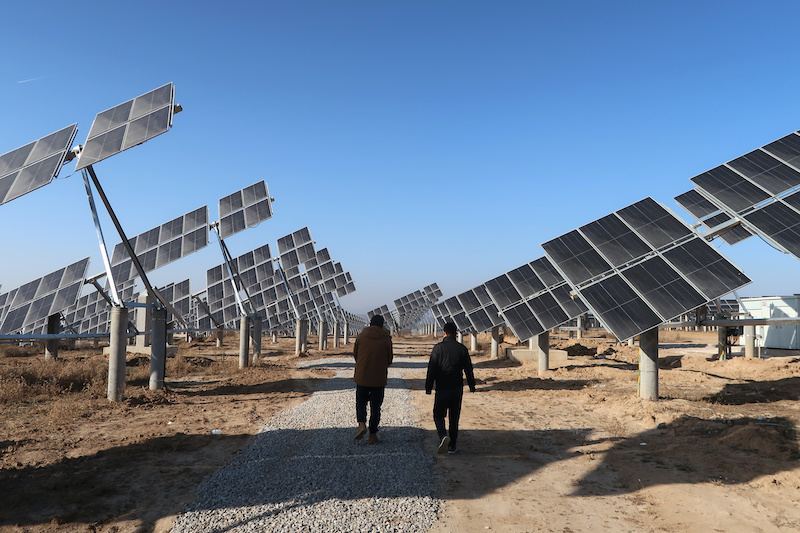
Shares of solar panel makers in China shot up on Wednesday after reports that Elon Musk had sent staff to visit photovoltaic suppliers.
The reports by local media stirred speculation that the world’s richest man is looking to expand production of solar cells in the United States.
Shares of JinkoSolar, a huge producer of solar panels, jumped 20% in early trading, while other big panel makers such as Trina Solar and Shenzhen Topraysolar rose by 9-10%. Jolywood Suzhou Sunwatt, a maker of PV materials, also rose by 20%.
ALSO SEE: China Slams Panama Ports Verdict, Hutchison Files New Case
Musk’s team visited companies involved in making equipment, silicon wafers, battery modules and perovskite technology, according to a report by CNBC, which noted that heterojunction and perovskite technologies were next-generation approaches that seek to boost cell efficiency and the latter could lower costs if manufacturing challenges are resolved.
State-backed Calian Press said the visitors came from Tesla and SpaceX, while 21st Century Business Herald said JinkoSolar confirmed the visit but gave no other details.
In a Tesla earnings call last week, Musk said he planned to build 100 gigawatts of solar cell capacity in the US, adding: “The solar opportunity is underestimated.”
This has prompted speculation that tech giants are moving upstream into the power sector.
Solar ‘set to top coal in China’
Meanwhile, China’s Electricity Council has projected that solar capacity looks set to surpass coal capacity this year for the first time.
It expects that wind and solar will provide nearly half of the country’s power capacity by the end of 2026.
And with if hydropower and nuclear power are added, those four types of ‘clean energy’ will total close to two-thirds of overall power capacity — so coal would only provide about a third.
Currently, coal accounts for about half the power produced in China, according to a report by Yale 360, which said solar and wind are starting to displace coal.
China has continued to build new coal plants, but most are burning less coal and a large share of them operate at a loss, compared to wind and solar.
“Under the latest government guidelines, coal will begin serving a more limited role. Increasingly, coal generators will act as “peaker” plants, meeting sudden spikes in power demand or gaps in the supply of wind and solar,” it said.
‘Big China decision looming’
Top analyst Lauri Myllyvirta, with the Centre for Research on Energy and Clean Air, told Yale Environment 360 that China has to decide in the next year or two whether to slow the building of coal plants — or start closing older coal power plants.
“The two biggest choices will be how to go about reforming the grid — China’s grid management is still quite outdated and rigid, and that will have to change if the country is to keep adding vast amounts of solar and wind. And the other question is, how do the policymakers react when the use of coal-fired power plants begins to fall sharply?
“Since 2020, they’ve pursued this all-of-the-above, all-hands-on-deck response to the electricity shortages that they experienced from 2020 to 2022. China permitted a lot of new coal-fired power plants in the early years of this decade. And those projects are now beginning to be completed.
“So now we have a situation where demand for power generation from coal is falling because of all the clean energy coming on, and at the same time, those brand-new coal-fired power plants are starting to connect to the grid.
“That will mean the use of coal power will fall, and the profitability of coal-fired power plants will fall. And then decision-makers have to make up their minds about whether they want to start closing down some of those plants, or whether they will put brakes on the clean energy expansion to give the coal industry some breathing room. And that is, of course, a hugely consequential choice.”
- Jim Pollard
ALSO SEE:
China Planning to Put AI Data Centres in Space Over Next 5 Years
China to Spend $574 Billion on Power Grids Amid Renewables Push
China, India See First Drop in Coal Power Use in Half a Century
Asia’s Billion-Dollar Carbon Boom?
China’s One Trillion Watt Solar Journey
Surge in Solar Power, Data Centres Spurs Battery Boom in China
China’s Fossil Fuel Power Generation Set For First Fall In A Decade
Renewables Top Coal Power for First Time in First Half of 2025
US Says Hidden Radios Found in Solar Highway Tech From China
Solar Power Boom Surging in Indonesia, Australia, Africa
China Lays Down Law to Solar Panel Makers: End Overproduction
China’s Desert Greening Projects Altering its Water Table: Study
Asia-Pacific ‘Faces $500bn Yearly Floods Hit if Warming Continues’