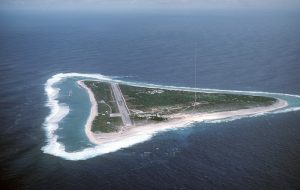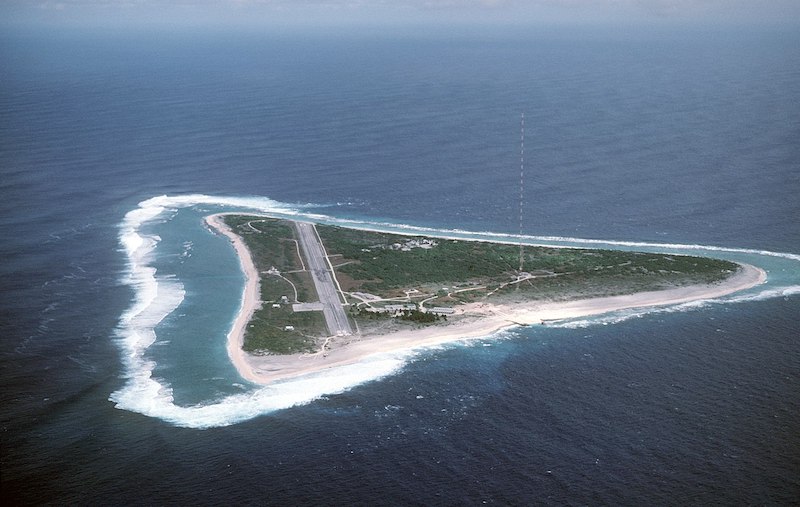
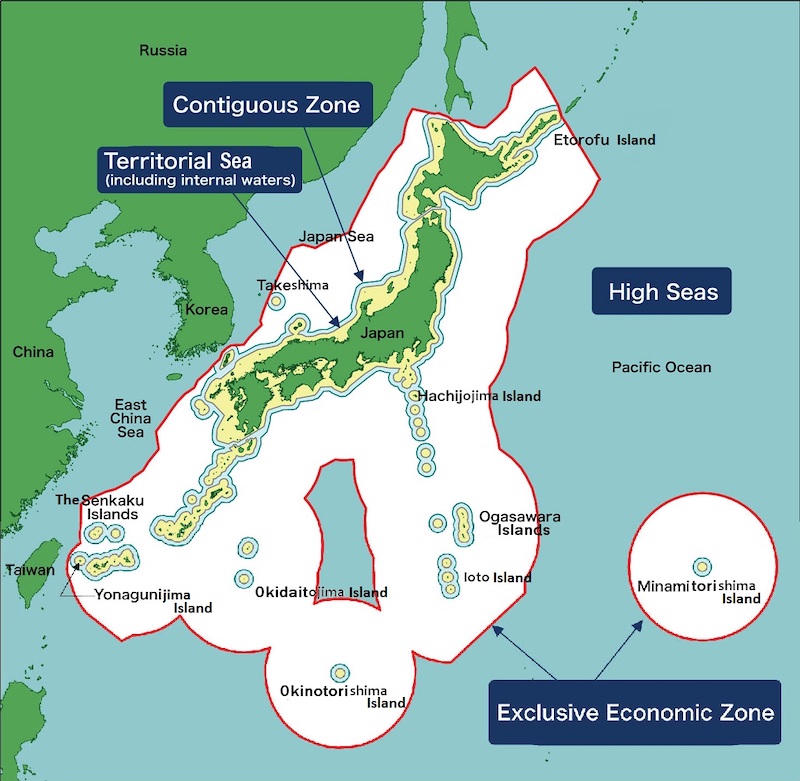
Japan said on Tuesday it will start to do test mining of mud that is rich in rare earth elements and manganese from deep in the sea off Minamitori, its most eastern and remote island.
The latest news is no surprise, given a survey team reported last year that more than 230 million tonnes of manganese nodules had been found off Minamitori, a tiny island 1,900 kilometres (1,180 miles) southeast of Tokyo.
Manganese is not a rare earth element (REE). It is abundant but is classed as a critical mineral, as it has an essential role in steelmaking, batteries and other technologies, similar to REEs, cobalt and lithium.
ALSO SEE: China Vanke Seen Seeking Short Extensions to Delay Debt Rejig
The project will run from January 11 to February 14, the head of the government-backed project said. The operation will mark the world’s first attempt to continuously lift rare-earth mud from a depth of around 6,000 metres to a vessel on the surface.
Tokyo, like its Western allies, is seeking to secure stable supplies of critical minerals as China, the dominant supplier of rare earths, tightens export controls.
“One of our missions is to build a supply chain for domestically produced rare earths to ensure [a] stable supply of minerals essential to industry,” Shoichi Ishii, programme director of the Cabinet Office’s national platform for innovative ocean developments, told reporters.
The Japanese government is pressing ahead with a national project as part of broader efforts to strengthen maritime and economic security.
Environmental impacts to be monitored
The test project in January-February will focus on connecting the deep-sea mining system and confirming its ability to lift 350 metric tons of rare-earth mud per day. Environmental impacts will be monitored both onboard and on the seabed throughout the operation.
No production target has been set, but if successful, a full-scale mining trial will be conducted in February 2027.
The government-funded project has spent about 40 billion yen ($256 million) since 2018, Ishii said, though estimated reserves have not been disclosed.
Ishii also said that while their research vessel was conducting rare earth surveys within Japan’s exclusive economic zone (EEZ) around Minamitori Island from May 27 to June 25, a Chinese naval fleet entered the waters on June 7.
“We feel a strong sense of crisis that such intimidating actions were taken, despite our activities being limited to seabed resource surveys within our EEZ,” he said.
Concern over deepsea mining
The international reaction to Japan’s move will be interesting, particularly the response from China, given the aggressive response from Beijing to a remark about Taiwan by Sanae Takaichi, Japan’s new prime minister.
But many could argue that China’s imposition of controls imposed exports of rare earths in April is a prime cause of countries like Japan wanting to recover critical minerals under the sea.
Environmentalists have concerns about deep-sea mining because the process, usually done by robots that vacuum up nodules on the sea floor, creates two plumes of sediment on both the sea floor, possibly higher up, if nodules are cleaned near the surface.
Scientists have expressed worry about the impacts on fish and other species in fragile underwater ecosystems if sediment is swept well beyond the mining zone.
Japan’s move could spur a geopolitical spat, or at least greater international debate, as some countries say deep-sea mining is a breach of international law.
However, the US is not a signatory to the UN Convention on the Law of the Sea. Indeed, President Donald Trump is likely to support the latest move by Tokyo, as he signed an executive order in April that expedited licence approvals for deep-sea mining in US and international waters.
Global issue
The reaction from other island nations will also be interesting. The president of Palau, a nation of about 500 islands between Guam and the Philippines in the western Pacific, has expressed fears that without proper protections in place, the impacts on the ocean could be irreversible.
President Surangel Whipps Jr has been quoted as saying: “What lies in the deep sea does not belong to any one nation or corporation, but to all of us and future generations.”
However, other Pacific island nations, such as the Cook Islands, believe the environmental risks are less serious and have allowed exploration for deep-sea minerals. This year the Cook Islands signed agreements allowing both Chinese research vessels and US firms to collaborate on research, exploratory surveys in its exclusive economic zone.
But it has not yet granted a commercial licence for deep-sea mining, which is opposed by some islanders, as well as activist groups such as Greenpeace. Any decision on the extraction of seabed minerals and commercial production has been pushed back to 2032 to allow for further environmental study and research.
China and Canada’s The Metals Company have also reportedly had talks with other nations like Kiribati, while Nauru and Tonga have partnered with other companies for similar exploration.
More than a dozen countries are said to have expressed interest in mining adjacent seabed areas. They include China, Japan, India, Papua New Guinea, American Samoa, as well as countries outside the Asia-Pacific, such as Norway, Sweden, Namibia, South Africa, Saudi Arabia, Brazil and Chile.
It’s a big issue and starting to get hotter.
- Jim Pollard with Reuters
ALSO SEE:
Vast Amount of Rare Metals Found Off Remote Japanese Isle
China Says It’ll Approve Rare Earth Licences For ‘Civilian Use’
China Ramps up Trade Pressure on Japan Over Taiwan Remark
Japan Signs Rare Earths, Nuclear Power Deal With Trump
China Curbs Rare Earth Exports to Defence Firms, Chipmakers
China Stops Most Antimony Exports But Rare Earth Sales to US Soar
China Did Not Agree to Military Use of Rare Earths, US Says
Trade Deal Signed, But China Still Slow to Release Rare Earths
China Export Curbs on Rare Earth Magnets: a Trade War Weapon
Lessons From Japan on Tackling China’s Rare Earth Dominance