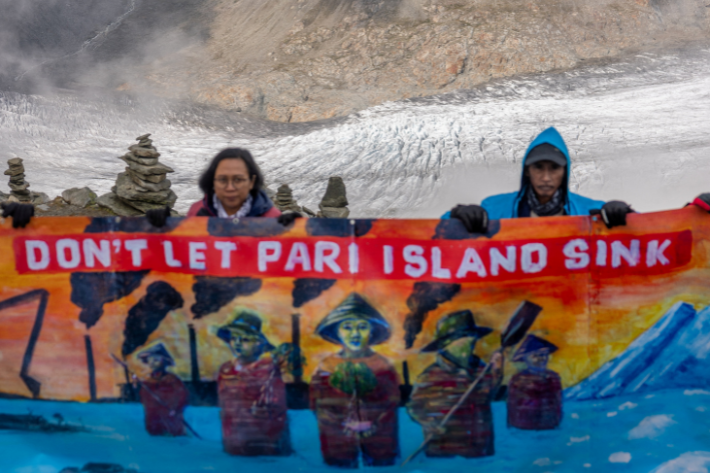
A group of Indonesian islanders have won a bid to fight a climate case against Swiss cement-maker Holcim, after a court in Zug said the complainants had a right to legal protection from the firm’s emissions.
The group of four residents, from the low-lying Indonesian island of Pari, submitted a legal complaint against Holcim in January 2023 and had been waiting for the court to admit their case.
Pari has faced repeated floods as warmer temperatures push up sea levels, and complainants say Holcim is doing too little to cut carbon emissions and hence contributing to global warming.
Also on AF: Surge in Solar Power, Data Centres Spurs Battery Boom in China
Rising waters linked to climate change could submerge most of Pari island by 2050, the European Centre for Constitutional and Human Rights (ECCHR) has previously said.
Cement production accounts for about 7% of global CO2 emissions, the Global Cement and Concrete Association says.
The Cantonal Court of Zug recognised “the plaintiffs deserve legal protection as people whose very existence is affected by climate change,” NGOs backing the islanders said in a statement on Monday.
The statement noted that the case marks the first time a court has admitted climate litigation brought against a large corporation in Switzerland.
“We are very pleased. This decision gives us the strength to continue our fight,” Ibu Asmania, one of the four Pari residents pursuing the case, said in the statement. “This is good news for us and our families.”
The NGOs, which include HEKS, ECCHR and the Indonesian Forum for Environment (WALHI), said they had chosen Holcim because it was one of the main carbon dioxide emitters worldwide and a so-called “carbon major” in Switzerland.
Challenges remain
The NGOs noted that in admitting the case, the court in Zug rejected some of Holcim’s major arguments against the case.
Holcim insisted that “the courtroom is not the appropriate forum to address the global challenge of climate change.” But the court insisted that “Court decisions do not (replace) democratically legitimised (…) climate protection policy but complement it.”
The cement giant also argued that Pari island “was doomed anyway,” the NGOs said in their statement. In response, the court said that “every single contribution is essential for counteracting climate change,” they noted.
The court was also unconvinced by Holcim’s argument “that other cement and concrete producers might generate more emissions if Holcim reduced its own emissions”, saying a win by the plaintiffs would “send a message to other cement companies.”
“Harmful behaviour [is] not legitimate because others behave in the same way,” the court noted further.
The court’s ruling is “an important step towards greater climate justice,” the NGOs said in the statement.
Still, the court in Zug also said that while it had admitted the case, the move could still be reversed if, in subsequent appeal proceedings, it concluded that procedural requirements are not met.
Holcim said it intends to appeal the decision and that the question of “who is allowed to emit how much CO2” should be a matter for lawmakers, not a civil court.
Compensation and climate action
According to the Swiss Broadcasting Corporation, the cement giant has previously argued that “it is affected by climate change to the same extent as the global population”.
Rejecting the islanders’ filing in September, it said their case showed no concrete, legally protectable interest. It also said it was fully committed to reaching net zero by 2050 and that it is following a rigorous, science-based approach to achieve that goal.
The company also says it has reduced direct CO2 emissions from its operations by more than 50% since 2015.
But research by HEKS and US-based Climate Accountability Institute showed in 2022 that Holcim released more than 7 billion tonnes of planet warming carbon dioxide between 1950 and 2021. That would account for roughly 0.42% of global industrial emissions during that time.
The four claimants — Ibu Asmania, Pak Arif, Pak Edi and Pak Bobby — have asked for 3,600 Swiss francs (about $4,500) per person from Holcim to cover damages from those emissions and fund climate action, like mangrove planting and breakwater construction.
According to HEKS, this sum represents 0.42% of the true expenses — matching projections of Holcim’s share in emissions.
Aside from compensation, the plaintiffs have also demanded that Holcim cut its greenhouse gas emissions by 43% by 2030 and by 69% by 2040. They have also asked for funding for flood protection.
- Vishakha Saxena
Also read:
UN Court Lays Ground For Action Against Countries’ Climate Inaction
Bold Climate Action Can be Great for Business, Study Finds
China’s Losses From Floods, Disasters in First Half: $7.6 Billion
Climate Change Leaves Japan’s Iconic Mount Fuji Snowless
Floods or Drought: Climate Change Worsens Global Water Woes
Asia is Warming Faster, Hit Hardest by Climate Disasters: WMO
Asian Economies at Risk From Inaction on Climate Change: ADB
China, India Ask Rich Nations For ‘Trillions’ in Climate Finance
Will Extreme Weather Break Asia’s Supply Chains?
Continued Fossil Fuel Investments Put $557 Trillion ‘At Risk’
Emissions of World’s Super Rich ‘Drive Economic Losses, Deaths’
Zero-Carbon Breakthrough For Industry’s Dirty Businesses
US Researchers Make Cement With 98% Less CO2
Biochar Can Cut Cement Use In Construction, Researchers Say