China’s emissions have maintained a ‘flat or falling’ trajectory for nearly two years, new research has shown, raising hopes that the world’s biggest emitter of planet warming gases may have finally hit its carbon peak.
“If this is China’s peak… it’s the climate story of the century so far,” wrote Simon Evans, senior policy editor at Carbon Brief, which published the analysis.
The research, conducted for Carbon Brief by the Centre for Research on Energy and Clean Air (CREA), showed that China’s emissions declined by 1% in the last quarter of 2025, and 0.3% for the year.
Also on AF: 4,000 CEOs Say No Impact From AI: Study Spurs Huge Selloff
That decline meant that China’s emissions had now stayed flat or fallen for the past 21 months, thanks to a boom in renewable energy capacity, CREA noted.
Clean energy growth helped China offset carbon from its power sector, which accounts for the largest share of the country’s emissions. Effectively, emissions from the sector were down by 1.5% year-on-year in 2025.
But, behind the good news, fear lingers that there is still a chance that China’s emissions may jump again and that current declines are well short of targets Beijing has previously set.
Fossil fuel dependence
Key to that worry is China’s continuing reliance on fossil fuels to maintain energy security and grow its industries.
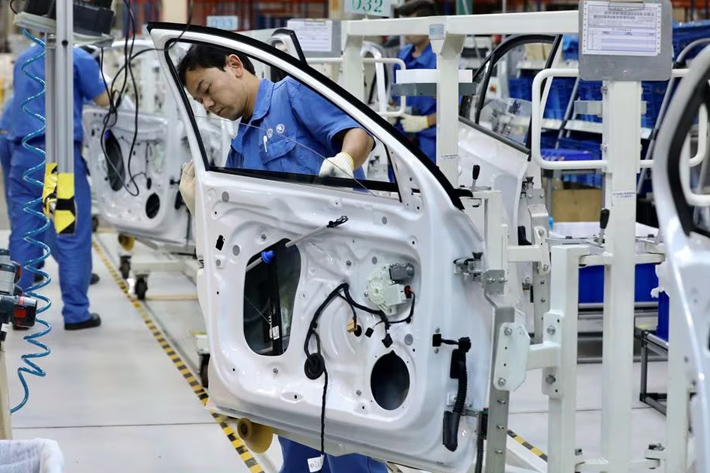
For instance, the country’s emissions from fossil fuels actually grew 0.1% in 2025. Furthermore, while most major sectors, including transport, power, cement and metals, cut their emissions, the chemicals industry remained an outlier due to its outsized dependence on fossil fuels.
The sector increased its coal and oil use by 15% and 10% respectively, CREA’s Lauri Myllyvirta noted.
“Without the increase from the chemicals sector, China’s total CO2 emissions would have fallen by an estimated 2%,” he added.
China’s coal use, in particular, remains a big cause for concern. Its coal-to-chemicals industry (converting coal to fuels / plastics) is aiming for massive expansions in capacity, Myllyvirta noted.
Meanwhile, despite the jump in clean energy installations, Beijing has continued to add a huge number of coal and gas-fired power plants.
“In 2025 alone, China commissioned more coal power capacity than India did over the entire past decade,” Global Energy Monitor’s climate and energy analyst Christine Shearer told ABC News early this month. Much of that newly added capacity is expected to come online this year.
Potential for emissions spikes
The staggering growth in coal capacity stems largely from Beijing’s commitment to maintaining energy security for its more than 1.4 billion people.
A growing middle-class, increasing industrial activity, booming artificial intelligence and electric vehicle use and climate change-related extremes in weather have been the key drivers of China’s power demand. EV charging alone consumed 49% more energy than last year, while tech services used 16% more power, according to the South China Morning Post.
Chinese officials, meanwhile, have left the door open to greater coal use, proposing that Beijing should look to reach a peak in coal consumption by 2027.
If Beijing returns to coal to meet its ever-increasing electricity demand, it could easily push the country’s emissions to a new high, especially as levels at present are not too far below their peak hit in 2024.
Silver linings
Despite those concerns, Beijing’s definitive strength in producing and employing green technologies has the potential to keep its emissions from growing.
According to CREA’s analysis, China continues to add clean power capacity faster than the overall growth in its energy demand. That trend “is the key reason why China’s emissions have been stable or falling since early 2024,” Myllyvirta said.
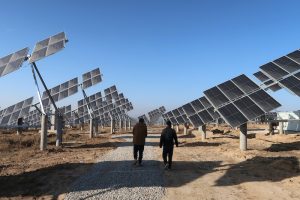
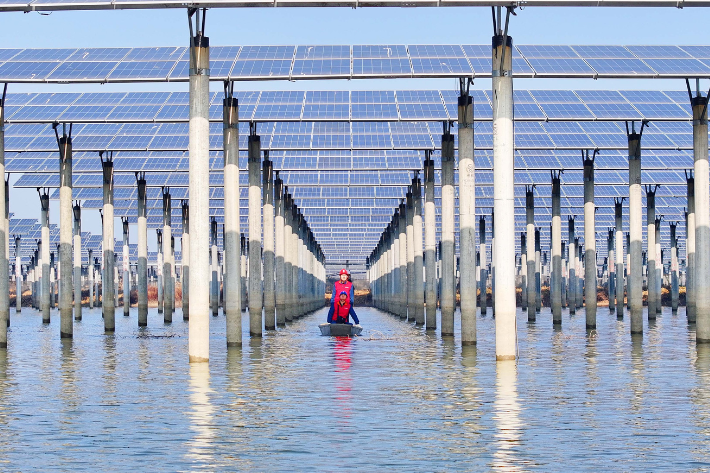
In 2025, all clean energy sources – including solar, hydro, wind and nuclear power – registered strong growth. Electricity generation from solar increased by a whopping 43%, CREA said. Those additions are expected to boost clean-power generation in 2026.
And for the first time ever, growth in China’s energy storage capacity also far outpaced peak electricity demand last year. “The growth in energy storage could provide China with an alternative way to meet peak loads without relying on increased fossil fuel-based capacity,” Myllyvirta said.
Policy actions to look out for
Whether China truly manages to keep its emissions trending downward will depend entirely on Chinese policy decisions. A general direction on those could become apparent by next month when Beijing presents its 15th five-year plan, CREA said.
The plan will need to address China’s carbon intensity which remains 6 percentage points short of the 18% target set for the 2020-25 period. Carbon intensity refers to emissions per unit of GDP.
Policymakers will need to aim for a sharper 23% cut in carbon intensity over the next five years for Beijing to meet its commitments under the Paris Agreement, CREA said. They will need to set limits on the planned expansions of the coal-to-chemicals industry.
Prioritising growth in storage capacity and clean energy to mitigate the risk of a potential spike in emissions will be key too. So far, Chinese policymakers have set lower-than-required targets in both those areas, CREA noted.
Another key piece of the puzzle will be grid capacity. Power generation from solar and wind is yet to reach its maximum potential, due to inefficient grids. Often, that leads to renewable sites being switched off to prevent grids from getting congested, CREA noted.
In January, Beijing announced plans to spend $574 billion to upgrade its power grids, but how much of that will be used to improve renewable capacity remains to be seen.
A huge chunk of those investments is expected to focus on Beijing’s push to reliably power the country’s massive network of data centres.
- Vishakha Saxena
Also read:
China, India See First Drop in Coal Power Use in Half a Century
Surge in Solar Power, Data Centres Spurs Battery Boom in China
China’s Fossil Fuel Power Generation Set For First Fall In A Decade
Renewables Top Coal Power for First Time in First Half of 2025
Solar Power Boom Surging in Indonesia, Australia, Africa
China Lays Down Law to Solar Panel Makers: End Overproduction
China’s Desert Greening Projects Altering its Water Table: Study
Asia-Pacific ‘Faces $500bn Yearly Floods Hit if Warming Continues
Half of Global C02 Emissions Come From 32 Companies: Report
Asia’s Billion-Dollar Carbon Boom?
China’s One Trillion Watt Solar Journey